Snowshoe
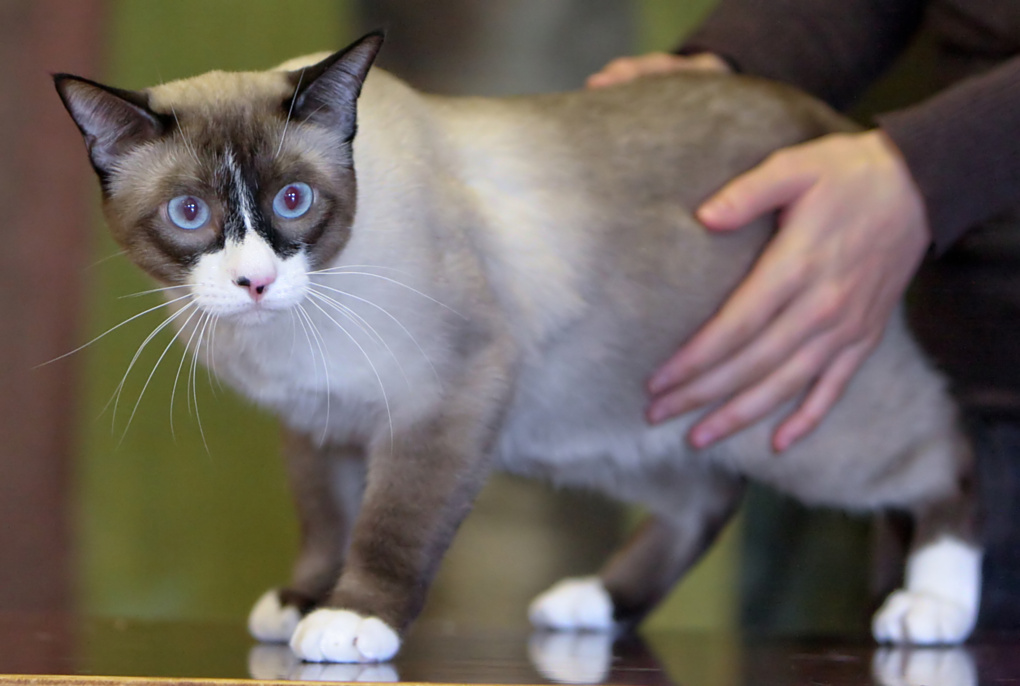

- Origin
- United States
- Type
- Shorthair
- Size
- Medium
- Coat
- Short to medium-short, smooth and glossy, no noticeable undercoat
- Colors
- Pointed with white feet and white on the face; blue eyes
- Status
- Rare; recognised by TICA, FIFe, the GCCF, the WCF and the ACFA
The Snowshoe is a rare breed of house cat that began in the United States in the 1960s. It is a short-haired, blue-eyed pointed cat with white markings, and it is named for its four white feet.
History
The breed started in Philadelphia, Pennsylvania, when a Siamese belonging to the breeder Dorothy Hinds-Daugherty had a litter in which three kittens had white feet. She set out to produce more cats like them, at first under the name Silver Laces, by crossing seal point Siamese with bicolor American Shorthairs. The first generation had no points, but breeding those cats back to Siamese gave the look she wanted.
The program later passed to Vikki Olander. Olander wrote the first standard and in 1974 won experimental status for the breed from the Cat Fanciers Federation and the American Cat Association. By 1977 she was the only Snowshoe breeder left in the country. Jim Hoffman and Georgia Kuhnell then joined her, others followed, and the CFF granted champion status in 1983. The American Cat Fanciers Association did the same in 1990, TICA recognised the breed in 1993 and FIFe gave full recognition in 2004. Breeders are still working toward acceptance by the Cat Fanciers’ Association, held back by the small numbers of cats and breeders.
Appearance
The Snowshoe is a medium-sized cat that joins the solidity of the American Shorthair with the length of the Siamese. The body is long, firm and muscular without being bulky, more runner than weightlifter. The head is a broad, slightly rounded wedge. The ears are medium to medium-large, broad at the base and slightly rounded at the tips. The eyes are blue, walnut-shaped and slanted toward the ears.
The coat is short to medium-short, smooth and close-lying, with no noticeable undercoat; a plush or double coat is a fault. The body is pale with darker ears, mask, legs and tail. All four feet must be white, and the favored face marking is a white inverted V over the muzzle. The ACFA accepts seal and blue points; TICA and FIFe accept all point colors, and FIFe also allows tortoiseshell and tabby points. Kittens are born white, and their markings appear within one to three weeks.
The markings are hard to breed reliably, which is the main reason the cat is rare. The white boots often reach too high, stop too low or fail to appear, and no two Snowshoes have the same pattern.
Temperament
Snowshoes are affectionate, mellow and sweet-natured. They enjoy attention, get on with children and other pets, and are devoted to their owners. They dislike long hours alone and cope better with a second cat for company. They are intelligent cats that can learn to open doors and to fetch. Many like water, running water especially, and some will swim.
Care and health
The coat changes with the seasons and needs little grooming. In a review of more than 5,000 cases of urate bladder stones, the Snowshoe was over-represented, though on very small numbers.
Facts on this page were checked against Wikipedia and may have changed since.