Ocicat
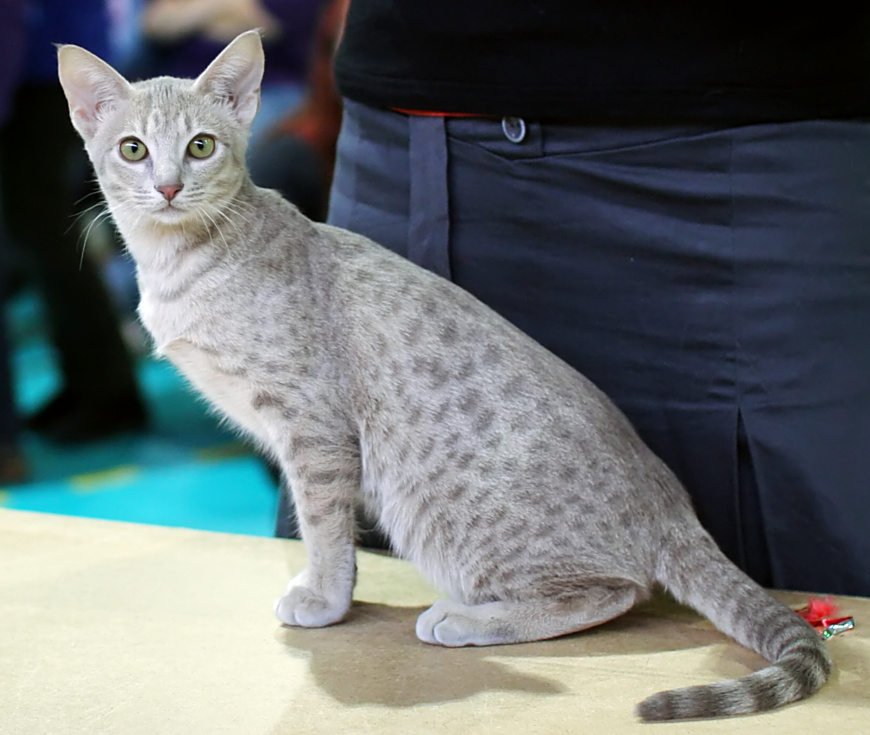

- Origin
- United States
- Type
- Shorthair
- Size
- Large
- Weight
- 2.5–6.5 kg (6–14 lb)
- Coat
- Short, spotted tabby
- Colors
- Twelve spotted colors: tawny, blue, chocolate, lavender, cinnamon and fawn, each also in silver
- Status
- Recognised by the CFA, TICA, FIFe and GCCF
The Ocicat is a spotted breed that looks like a small wild cat but has no recent wild ancestry at all. It was made by crossing Siamese and Abyssinian cats, with the American Shorthair added later, and is named for its resemblance to the ocelot.
History
The breed appeared by chance. In 1964 Virginia Daly of Berkley, Michigan, set out to breed a Siamese-type cat with Abyssinian-colored points. She mated a ruddy Abyssinian male to a seal point Siamese female, kept a daughter from the litter and bred her to a chocolate point Siamese. A later litter from this line included a kitten with cinnamon spots on an ivory coat. Daly’s daughter said he looked like an ocelot and suggested the name ocicat. The kitten, called Tonga, was sold as a pet for ten dollars and neutered.
A geneticist, Dr. Clyde Keeler, who was interested in recreating the spotted cats of ancient Egypt, encouraged Daly to pursue the type. She repeated the mating of Tonga’s parents and got a tawny spotted male, Dalai Dotson, and from then on bred for the spotted look. American Shorthairs were brought in to add substance and bone, and with them came silver.
The Cat Fanciers’ Association accepted the Ocicat for registration in 1966 and gave it championship status in May 1987. The International Cat Association recognised it in 1986 and FIFe in 1992. The first two Ocicats reached the United Kingdom in 1988, and the Governing Council of the Cat Fancy granted championship status in 2006.
Litters sometimes include kittens with a different tabby pattern instead of spots. The GCCF recognised these as a separate breed, the Aztec, in 2013, then in 2024 merged them back as a variety called the Ocicat Classic.
Appearance
The Ocicat is a medium to large, well-muscled and lithe cat, weighing 2.5 to 6.5 kg (6 to 14 lb). The head has gentle curves and a broad, well-defined muzzle. The ears are set at about 45 degrees. The eyes are large, almond-shaped and more than an eye’s width apart; any color but blue is accepted. The legs are medium to long, and the tail is long and slim with a dark tip.
Spots cover the body. The forehead carries the tabby M, with markings running back over the neck, and dark lines around the eyes and cheeks look like mascara. The tip of the tail is the darkest point on the cat. Twelve colors are recognised: tawny, blue, chocolate, lavender, cinnamon and fawn, and a silver version of each.
Temperament
Ocicats are often described as a dog in a cat’s body. Most can be taught to fetch, to walk on a harness and leash, to come when called and to sit or lie down on command.
Care and health
A review of more than 5,000 cases of urate bladder stones in the United States found the Ocicat far more often affected than most breeds. A Swedish study of pyometra, an infection of the womb, found the Ocicat had the third highest rate, about six times that of cats in general.
Facts on this page were checked against Wikipedia and may have changed since.