American Curl

- Origin
- United States
- Type
- Other
- Size
- Medium
- Weight
- 2.3–4.5 kg (5–10 lb)
- Coat
- Short or long, soft and silky, lying flat
- Status
- Recognised by the CFA and TICA
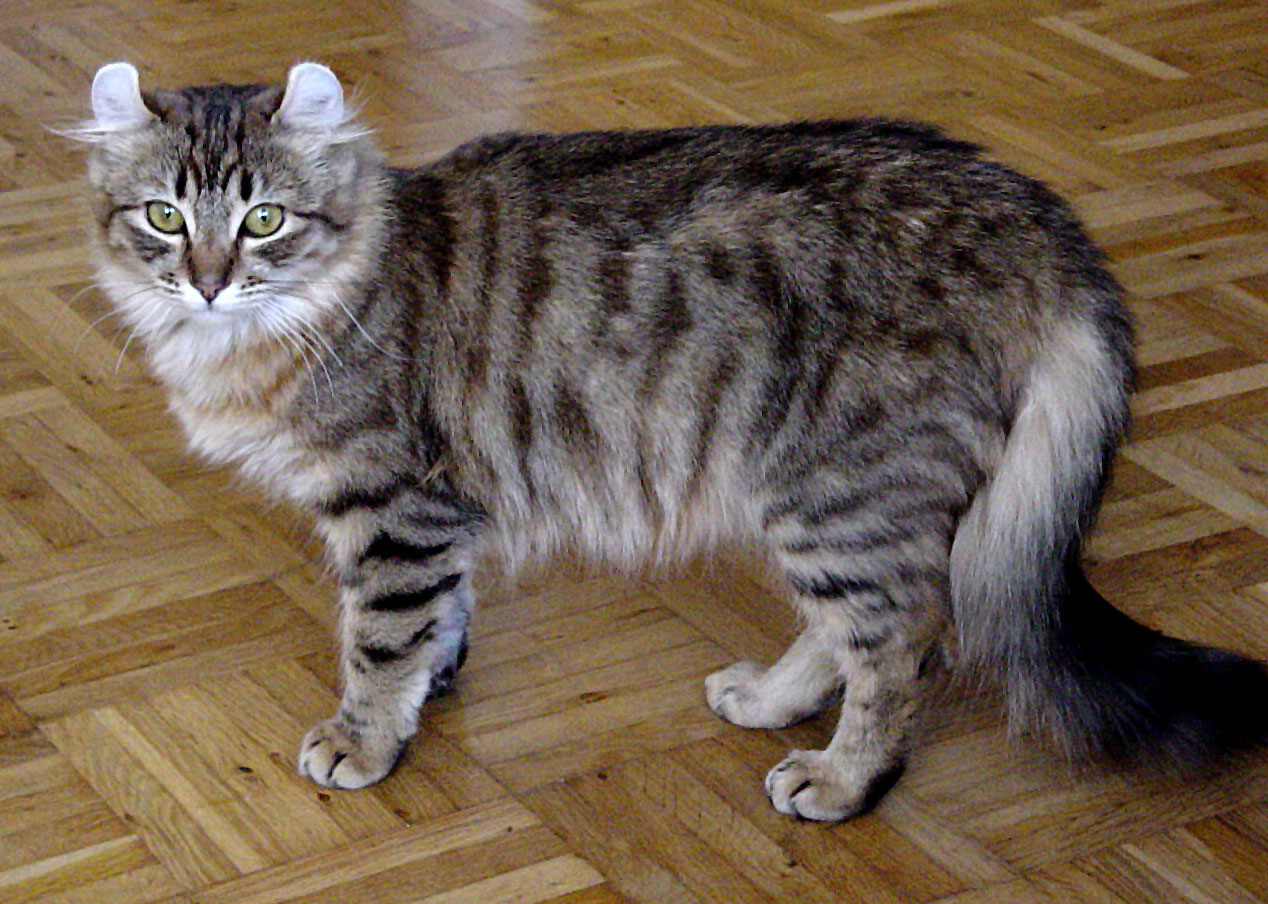
The American Curl is a house cat known for its ears, which bend backward, away from the face and toward the middle of the back of the head. The breed began in Lakewood, California, with a spontaneous mutation in a stray cat, and it comes in both a longhaired and a shorthaired form.
History
In June 1981 stray cats with curled ears turned up at the home of the Ruga family in Lakewood. One of them, a black female named Shulamith, had a litter whose kittens carried the same ears, and every American Curl alive today descends from her.
The breed was first shown in 1986. The International Cat Association gave the longhaired American Curl championship status in 1992. In 1999 the Cat Fanciers’ Association admitted it to its Championship Class, the first breed to enter with a longhair and a shorthair division together.
The American Curl is still uncommon, but it is now kept in many countries, among them the United States, Spain, France, Japan and Russia.
Appearance
This is a medium-sized cat weighing 2.3 to 4.5 kg (5 to 10 lb). Females are expected to be 2.3 to 3.6 kg and males 3.2 to 4.5 kg. It is slow to mature and is not fully grown until two or three years of age.
Kittens are born with straight ears. The ears start to curl within about forty-eight hours and go on changing until around four months, after which the curl is set. The finished ear is firm and stiff at the base and flexible at the tip.
Longhaired and shorthaired cats both have a soft, silky coat that lies flat against the body.
Care and health
The coat is considered fairly easy to look after.
Breeding trials showed that the curl is inherited as a dominant gene, named curl and written Cu, and that it is not linked to sex. Because the folded ears of the Scottish Fold come with cartilage and bone disease, researchers asked whether cats carrying two copies of the curl gene might suffer in a similar way. A cat with two copies that was watched for two years showed no abnormality.
Facts on this page were checked against Wikipedia and may have changed since.