American Shorthair
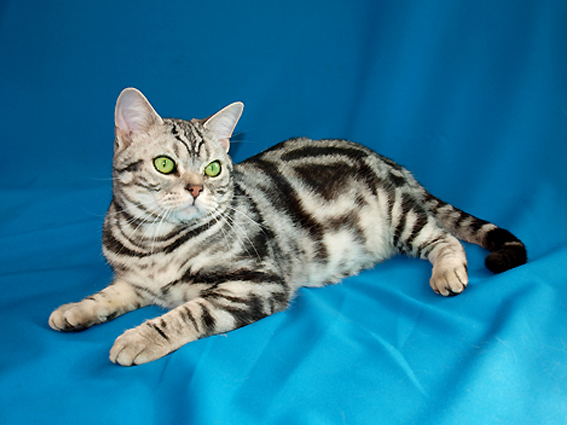

- Origin
- United States
- Type
- Shorthair
- Size
- Medium
- Weight
- 2.5–7 kg (6–15 lb)
- Coat
- Short
- Colors
- More than eighty colors and patterns
- Status
- Recognised by the CFA, TICA and CCA
The American Shorthair is a pedigreed house cat thought to descend from the cats that European settlers brought to North America aboard their ships. Those cats were carried to keep mice and rats out of the stores, and the breed that grew from them is still sometimes called a working cat. The Cat Fanciers’ Association (CFA) ranked it the eighth most popular pedigreed cat in the world for 2020.
History
Ships crossing from Europe kept cats on board to protect their supplies from rodents; the Mayflower is said to have carried cats that hunted rats on the ship and later in the colony. Many of these ship’s cats came ashore, bred among themselves and adapted to the climate and conditions of their new home. They went on to earn their keep on farms as well as on ships.
Early in the 20th century a selective breeding program was set up to fix the best qualities of these cats. Under its first name, the Domestic Shorthair, it was one of the first five breeds registered by the CFA in 1906. In 1966 the breed was renamed the American Shorthair. The new name reflected its American origins, set it apart from other shorthaired breeds, and made clear that it is a pedigreed cat with a written standard, distinct from the random-bred shorthaired house cats of North America, which can look much the same. Every North American cat registry accepts the breed.
Appearance
This is a medium to large cat. Males weigh 5–7 kg (11–15 lb) and females 2.5–5.5 kg (6–12 lb). The head is large and a little longer than it is wide, with medium-sized ears that are slightly rounded at the tips and large, wide eyes. The neck is of medium length and well muscled, the legs are medium in length and muscular, and the tail is of medium length and in proportion to the body.
More than eighty colors and patterns are recognised, from brown-patched tabby and blue-eyed white to the silvers (tabby, shaded, smoke and cameo) and the van-patterned calico. Cats whose color points to crossbreeding are generally disqualified from shows: chocolate, sable, lilac (lavender) and the pointed pattern of the Siamese family.
Care and health
A Japanese study of cats suspected of having kidney problems found that 47% of the American Shorthairs tested carried the PKD1 mutation, the cause of feline polycystic kidney disease. A review of more than 5,000 cases of urate bladder stones in the United States found that American Shorthairs were significantly less likely to develop them than mixed-breed cats.
Facts on this page were checked against Wikipedia and may have changed since.