Exotic Shorthair

- Origin
- United States
- Type
- Shorthair
- Size
- Medium
- Coat
- Short and dense
- Colors
- All colors and patterns
- Status
- Recognised by the CFA, TICA, FIFe and GCCF
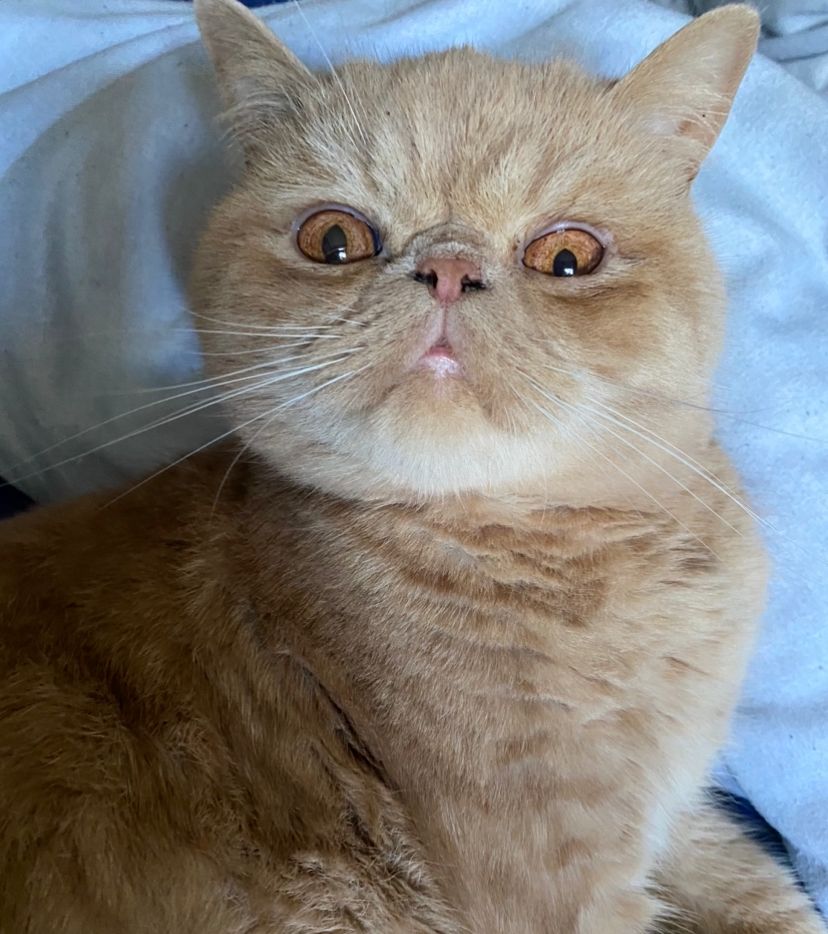
The Exotic Shorthair is a breed developed in the United States as a short-haired version of the Persian. In build and face it matches the Persian; the difference is its short, dense coat.
History
In the late 1950s some breeders of American Shorthairs quietly crossed their cats with Persians to improve their body type, and occasionally with Russian Blues and Burmese as well. The resulting cats did well at shows, but other American Shorthair breeders objected and had the standard rewritten so that cats showing signs of crossbreeding were disqualified.
One breeder saw the cross as worth keeping for its own sake. With the support of Jane Martinke, a Cat Fanciers’ Association judge and American Shorthair breeder, the cats were accepted as a new breed, the Exotic Shorthair, in 1966, and the CFA granted championship status the following year. The first Exotic reached the rank of Grand Champion in 1971. FIFe recognised the breed in 1986. In 1987 the CFA closed it to further shorthair outcrosses, which left the Persian as the only breed that may be crossed in. An Exotic was the CFA’s Cat of the Year in 1991, and another was its Best Cat in 2012.
Appearance
The Exotic is a medium to large cat built like a Persian. The head is large and round with full cheeks and big round eyes. The ears are small, rounded at the tips and set low, which adds to the broad, rounded look of the head. The tail is rather short for the body, and the overall shape is compact. The coat is short and dense, and it comes in every color and pattern, as in the Persian and the British Shorthair.
Because Persians are still used in breeding, some Exotics carry the recessive gene for long hair. When two carriers are mated, each kitten has a one in four chance of being longhaired. Registries handle these kittens differently: the CFA does not count them as Persians, TICA does, and the American Cat Fanciers Association registers them as a separate breed, the Exotic Longhair.
Care and health
Like the Persian, the Exotic is a brachycephalic breed, with a pushed-in face that brings health problems of its own. The notes list several conditions as common:
Brachycephalic airway obstructive syndrome is a set of upper airway abnormalities of varying severity that make breathing harder and can put strain on the heart. Corneal sequestrum is the death of part of the cornea, from an unknown cause. The large domed skull of the kittens can lead to difficult births.
Polycystic kidney disease, which can end in kidney failure, is inherited in Exotics as it is in Persians and related breeds. Ultrasound studies in developed countries have found it in 40 to 50 percent of Exotics, and DNA testing of breeding cats is recommended to reduce it.
A review of more than 5,000 cases of urate bladder stones found the breed strongly under-represented, with a single Exotic among them.
Facts on this page were checked against Wikipedia and may have changed since.