Sokoke

- Origin
- Kenya
- Type
- Shorthair
- Size
- Medium
- Coat
- Short, coarse and glossy, with little or no undercoat
- Colors
- Blotched tabby in shades of black to brown
- Life span
- Around 15 years
- Status
- Recognised by FIFe, the GCCF and the CCA; preliminary new breed in TICA; rare
The Sokoke is a natural breed developed from the khadzonzo, the free-living cats of the coast of Kenya. It is named after the Arabuko Sokoke forest, where its founders were collected, and was shaped as a breed mainly in Kenya and Denmark. Its first name was the African Shorthair.
History
Jeni Slater, a horse breeder and wildlife artist, came upon the cats in 1978 near a coconut plantation at Watamu, though local people had long known them. She raised kittens and coaxed in adult cats with food, and began a breeding program the same year.
Fearing for the cats’ future in Kenya, Slater let her friend Gloria Moeldrop take a pair to Denmark in 1983. They were shown in Copenhagen in 1984, and Moeldrop imported more in 1989. FIFe recognised the breed as the Sokoke in 1993, after breeders demonstrated it at a Danish show.
A second strain, known as the new line, came from cats gathered at the forest’s edge by Jeannie Knocker, a neighbor of Slater’s, and exported to Europe and the United States. Cats caught in the forest from 2001 on were added to it.
It was once rumored that the Sokoke was part wildcat. A DNA study found instead that the Sokoke, the street cats of eastern Kenya and the cats of the Lamu islands are close relatives, with ancestry mainly from Asian domestic cats. The Sokoke is no wilder than any other house cat.
The breed is among the rarest. FIFe’s figures for 2024 ranked it last, with no kittens registered that year.
Appearance
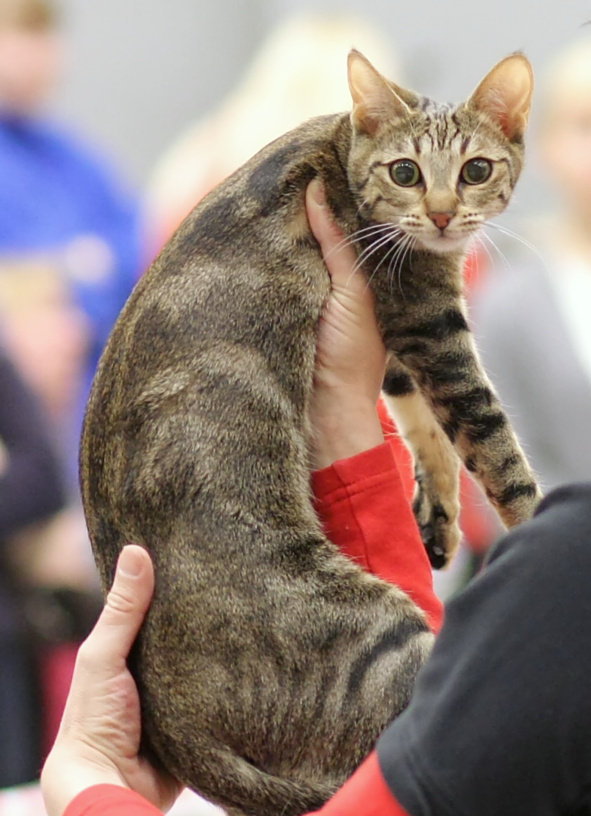
The Sokoke is medium-sized, long and thin. The hind legs are longer than the front legs, which, together with a straight stifle, gives the cat a tiptoe walk. The head is fairly small, with long ears and eyes that are usually amber to light green. The tail tapers.
The coat is short, coarse and glossy, with little or no undercoat. The usual pattern is a blotched tabby in black to brown. Ticked hairs lighten the middle of each blotch and give the whole coat a salt-and-pepper look; a wood-grain effect is prized in show cats. Pointed, black and blue cats turn up now and then but are mostly not accepted for showing.
Temperament
Sokokes are very active and like to climb. They tend to be talkative with people and with other cats. They form deep bonds with one another and with their owners, so adults and older kittens take longer to settle when rehomed.
Care and health
Sokokes have limited resistance to the common cat illnesses found in catteries and homes with many cats, so they do best in a controlled environment. Like other short-coated cats of Asian type they do not do well in long spells of severe cold, though they can get used to cooler climates and need no special housing. They can be expected to live as long as other pedigree cats, with 15 years an average old age.
Facts on this page were checked against Wikipedia and may have changed since.