Scottish Fold
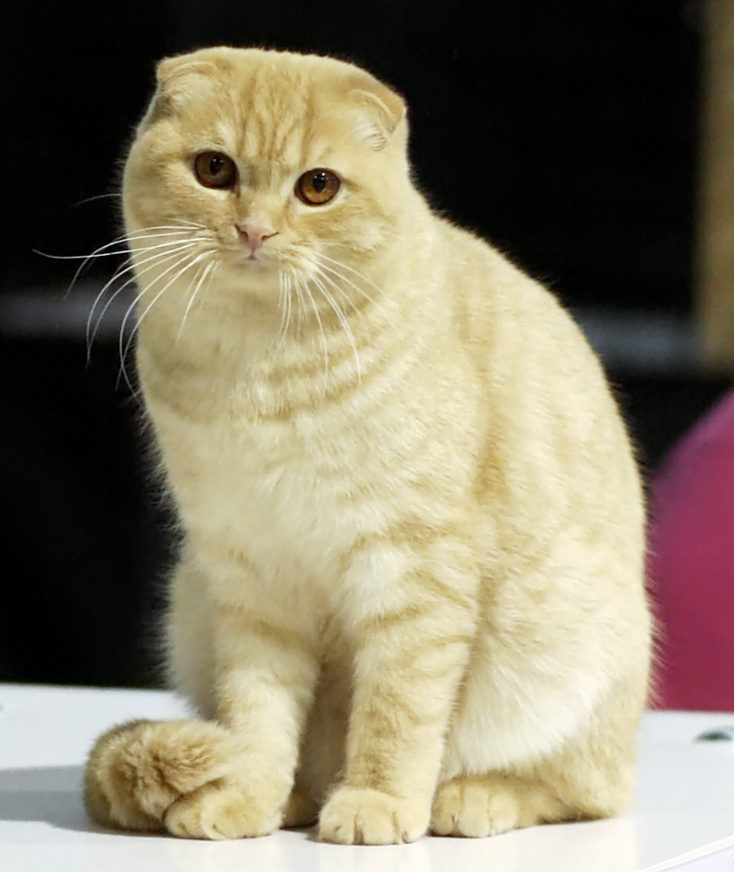

- Origin
- Scotland
- Type
- Shorthair
- Size
- Medium
- Weight
- 2.7–6 kg (6–13 lb)
- Coat
- Short, thick and soft; a longhaired form also exists
- Colors
- Any color or pattern
- Status
- Recognised by the CFA, TICA and WCF; not recognised by FIFe or the GCCF
The Scottish Fold is a breed of house cat whose ears fold forward and down toward the front of the head, giving it a look often compared to an owl. The fold comes from a naturally occurring dominant mutation that affects cartilage throughout the body, a condition called feline osteochondrodysplasia. Because the same mutation damages bones and joints, breeding Folds is prohibited in several countries, and some major registries do not accept the breed.
History
Every Scottish Fold goes back to Susie, a white barn cat found in 1961 on a farm near Coupar Angus in Tayside, Scotland. Two of her kittens had folded ears, and one went to William and Molly Ross, neighboring farmers who were cat fanciers. Their breeding program produced 76 kittens in three years, 42 of them with folded ears, which showed that a dominant gene was at work.
The cats were first called Lop-ears, after the rabbit, and took the name Scottish Fold in 1966, the year Ross registered the breed with Britain’s Governing Council of the Cat Fancy. The GCCF stopped registering it in the early 1970s over health concerns. By then Folds had reached the United States, in 1970, where they were crossed with American and British Shorthairs. The Cat Fanciers’ Association granted championship status in 1978. Longhaired Folds, known by names such as Highland Fold, were accepted for championship by TICA in 1987–88 and by the CFA in 1993–94.
Appearance
The Fold is a medium to large cat. Males usually weigh 4 to 6 kg (9 to 13 lb) and females 2.7 to 4 kg (6 to 9 lb). Everything about it is rounded: a domed head on a very short neck, full cheeks and whisker pads, large round eyes set wide apart, a short gently curved nose, and a padded body on medium to short legs. Small, tightly folded ears that sit like a cap are preferred to large, loosely folded ones.
The short coat is thick and soft; longhaired cats have longer fur with tufts at the extremities. Any color or pattern is possible. Kittens whose ears do not fold are called Scottish Straights.
Care and health
The mutation that folds the ears also affects the skeleton. Cats with two copies of the gene develop severe arthritis early, with bony growths around the joints of the hind legs and a short, stiff tail. Cats with one copy develop a progressive arthritis whose severity varies a great deal; a 2021 X-ray study found signs in such cats that were often mild and subtle. Folds are therefore mated to straight-eared cats rather than to each other, though severe cases have been reported from those pairings too. Some researchers recommend that breeding fold-eared cats stop altogether.
Breeding has been banned in the Netherlands (2014), Austria (2020), Flanders in Belgium (2021) and Victoria in Australia, and it is restricted in Scotland, Norway and Sweden.
Polycystic kidney disease is also common: a Japanese study of cats with suspected kidney trouble found the responsible mutation in 54 percent of the Scottish Folds tested. Genes linked to hypertrophic cardiomyopathy have also been found in the breed.
Facts on this page were checked against Wikipedia and may have changed since.