Chartreux

- Origin
- France
- Type
- Shorthair
- Size
- Large
- Coat
- Short, thick, water-resistant double coat
- Colors
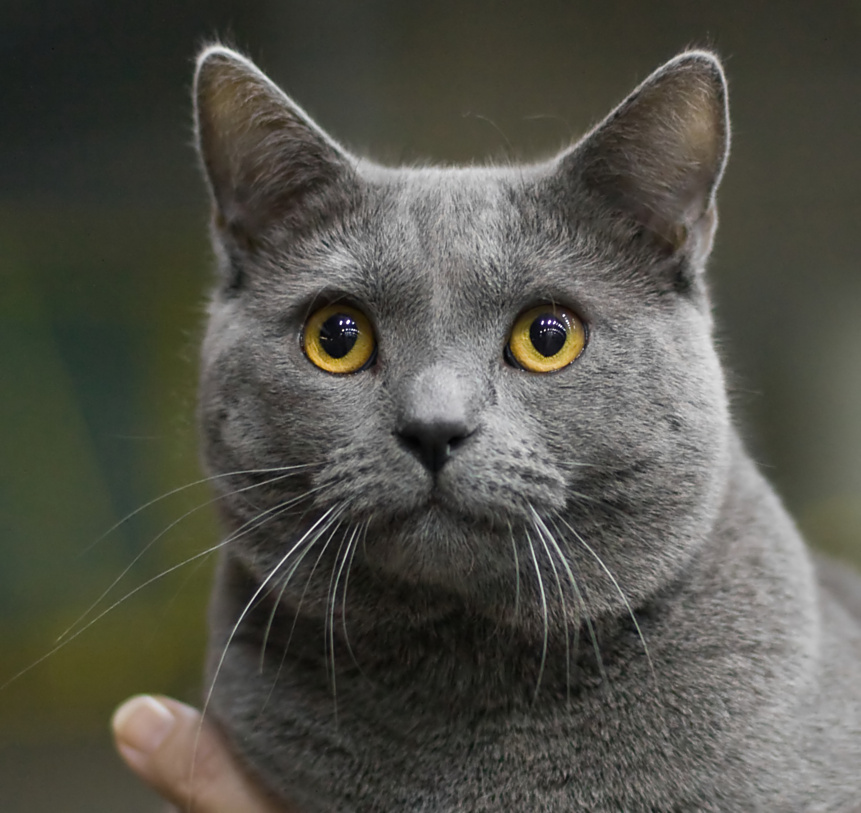
- Blue (silver-gray), with orange or copper eyes
- Status
- Rare; recognised by the CFA, TICA and FIFe
The Chartreux is a rare breed of cat from France. It is a large, muscular animal with a blue-gray double coat and orange or copper eyes, and it has long been valued on farms as a skilled hunter.
History
A blue-gray cat of this kind appears in French writing as early as 1558, in a poem by Joachim du Bellay about the death of a small cat. One is shown as a pet in a 1747 portrait by Jean-Baptiste Perronneau, which was unusual for the period, and the naturalist Buffon described the breed in the 18th century.
Two legends are told about its origin. One says the cats were brought to France by Carthusian monks and lived at their mother house, the Grande Chartreuse, in the mountains north of Grenoble. In 1972 the prior of the monastery said its archives held no record of the monks keeping any such cat. The other says the ancestors were feral mountain cats from what is now Syria, carried home by Crusaders in the 13th century.
The breed was badly reduced by the First World War, and free-living colonies were not seen after the Second, except perhaps on the island of Belle-Île-en-Mer, where the Léger sisters began breeding from the best cats they found. Later work by European breeders saved the Chartreux from disappearing. The first ones reached the United States in 1971, brought to La Jolla, California, by Helen and John Gamon, and the Cat Fanciers’ Association gave the breed championship status in 1987. In 2007 there were fewer than two dozen active breeders in North America.
The writer Colette, the poet Charles Baudelaire and President Charles de Gaulle all kept Chartreux. Like every pedigreed cat in France, a Chartreux is given an official name beginning with the letter assigned to its year of birth; the letters K, Q, W, X, Y and Z are skipped.
Appearance
The body is large, heavy and compact, the build that cat fanciers call cobby, and it stands on fairly short, fine-boned legs. The coat is short and blue, a silvery gray, with a dense undercoat that makes it water-resistant. It is thick enough to part into ridges like a sheepskin. The eyes are orange or copper. The shape of the head and the narrowing muzzle give the cat an expression that looks like a smile.
Temperament
Chartreux are quiet cats. They seldom meow, and a few are entirely silent. They are observant and clever: some have learned to switch a radio on and off or to work the latch of a screen door. They take about two years to mature and stay playful well beyond that, and some will fetch small objects. They are gentle, affectionate, good with children and other animals, and they travel well. A Chartreux often chooses one person in the household and follows them from room to room, while staying friendly with everyone else.
Care and health
The Chartreux is considered a generally very healthy breed.
Facts on this page were checked against Wikipedia and may have changed since.