Chantilly-Tiffany
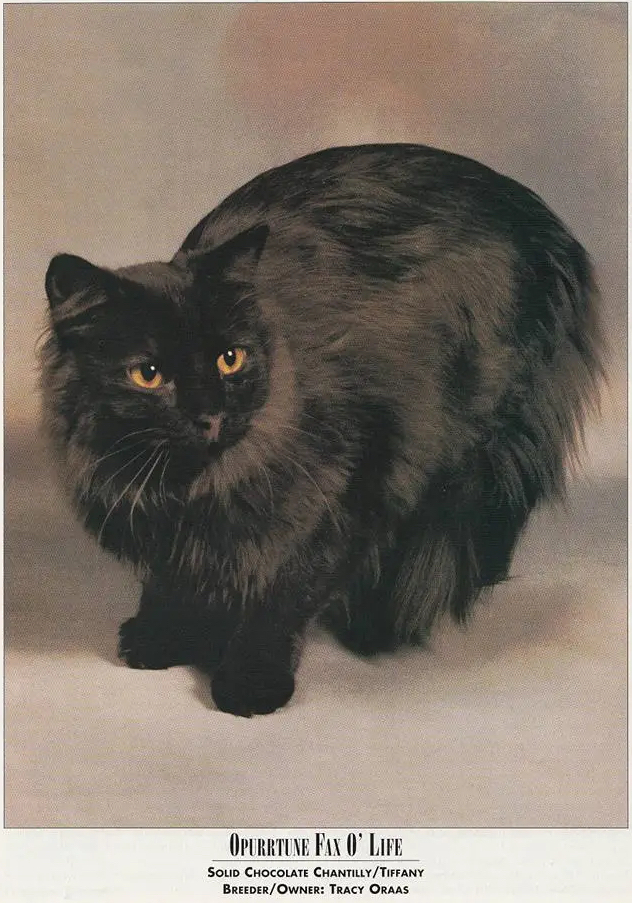

- Origin
- United States
- Type
- Longhair
- Size
- Medium
- Weight
- 2.5–5 kg (5.5–11 lb)
- Coat
- Semi-long, silky and soft, no undercoat
- Colors
- Originally chocolate; later also blue, lilac, cinnamon and fawn
- Status
- Extinct
The Chantilly-Tiffany, also called the Chantilly or Foreign Longhair, was a semi-longhaired breed that began in North America in the late 1960s. It was always rare, nearly died out twice, and has been considered extinct since 2015. It was unrelated to the Tiffanie, a British breed with a similar name with which it was often confused.
History
In 1967 Jennie Robinson of New York bought two long-haired chocolate cats with golden eyes at an estate sale in White Plains. Nothing was known of their background. The female, Shirley, had six kittens by the male, Thomas, in May 1969. All were chocolate and looked alike, and Robinson began breeding them. In the early 1970s the American Cat Association registered the cats as Foreign Longhairs.
When Robinson stopped, Sigyn Lund, a Burmese breeder in Florida, took the cats on and renamed them Tiffany. Because of her other breed, people assumed the cats were long-haired Burmese, and several cat books repeated the claim. Robinson and later breeders stated that Burmese were never used. The registry eventually dropped the breed for lack of numbers, and it lost its pedigree status.
In Canada, a long-haired chocolate cat of the same look turned up on a farm in 1973 and had kittens like herself. Her descendants were used to rebuild the breed. From 1988 the Canadian breeders Tracy Oraas and Jan DeRegt led a second revival, using Angora, Havana Brown, Abyssinian, Somali and Nebelung cats. In 1992 the name was changed to Chantilly to avoid confusion with the British Tiffanie. Several North American registries, TICA among them, accepted the cats as an experimental or new breed.
By 2003 one cattery was left in the United States, in Illinois, and it was destroyed by fire in 2012. The last male, Frosty, was sent to a Nebelung breeder in Norway and sired a single kitten in 2013. After he died, that kitten was neutered in 2015 and the line ended.
Appearance
The Chantilly had a semi-foreign build, neither stocky nor very slender, and a full, silky, semi-long coat with a plumed tail, a ruff at the neck and tufts in the ears. The head was a broad, gently curved wedge with a medium nose and a short, softly squared muzzle. The eyes were oval to almond-shaped and set wide apart. They were always yellow to gold, deepening with age. Green eyes were not allowed.
The first cats were all chocolate. Blue, lilac, cinnamon and fawn were accepted later, and one standard added black. Solid, mackerel, ticked and spotted tabby patterns were allowed. The breed matured slowly, taking one to two years to reach its full coat and color.
Care and health
The coat had no undercoat, and the breed’s founders and one breed standard described it as easy to groom and light on shedding. Some sources reported the opposite: that Chantillys groomed themselves too much and pulled out hair, leaving bald patches and causing hairballs.
Facts on this page were checked against Wikipedia and may have changed since.