Munchkin
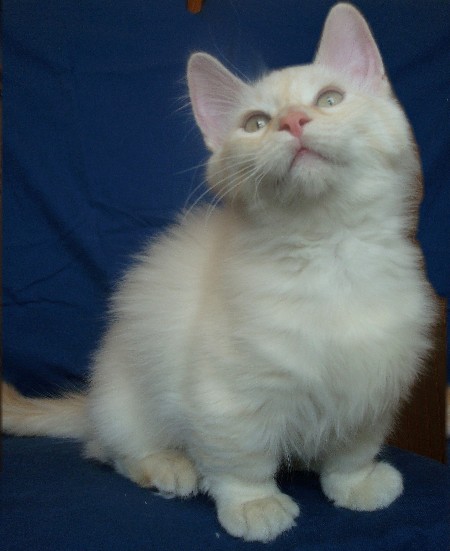

- Origin
- United States
- Type
- Dwarf
- Size
- Small
- Weight
- 1.8–4.1 kg (4–9 lb)
- Coat
- Medium-plush shorthair or semi-long silky longhair
- Colors
- All colors and patterns
- Status
- Recognised by TICA and the WCF; not recognised by the CFA, FIFe or GCCF
The Munchkin is a breed defined by its very short legs, the result of a genetic mutation. It is regarded as the original dwarf cat breed. The name comes from the small people of Munchkin Country in L. Frank Baum’s The Wonderful Wizard of Oz. The breed has been controversial from the start, and several registries and countries reject it because of concerns for the cats’ welfare.
History
Short-legged cats have been noted around the world since the 1940s. A British veterinary report of 1944 described four generations of them; that line died out during the Second World War. Others were seen in Russia in 1956 and in the United States in the 1970s.
Today’s breed goes back to 1983, when Sandra Hochenedel, a music teacher in Rayville, Louisiana, found two pregnant cats that a dog had chased under a truck. She kept one, named her Blackberry, and found that half her kittens had short legs. A short-legged male from one litter, Toulouse, went to her friend Kay LaFrance. The breed descends from Blackberry and Toulouse.
The Munchkin was shown to the public in 1991 at a televised TICA show in Madison Square Garden. TICA accepted it into its new breed program in September 1994, at which one veteran judge resigned in protest, and recognised it in 1997. The registries that fully recognise it now are TICA, the Southern Africa Cat Council, the Australian Cat Federation, the World Cat Federation and Catz Incorporated in New Zealand. FIFe, the GCCF and the CFA do not.
Appearance
Apart from its legs, the Munchkin looks much like an ordinary domestic cat, because such cats are its usual outcross. It is small to medium-sized with a moderate body. Males typically weigh 2.7–4.1 kg (6–9 lb) and females 1.8–3.6 kg (4–8 lb). The hind legs may be a little longer than the front, so the back rises slightly toward the rump. Slightly bowed legs are accepted, but strong bowing disqualifies a cat from shows.
The shorthaired Munchkin has a medium-plush coat and the longhaired one a semi-long, silky coat. All colors and patterns occur. Sources disagree on whether the short legs limit running and jumping.
Care and health
The short legs are caused by a chondrodysplasia, a disorder of cartilage and bone growth. The gene is dominant, and only cats with one copy survive: kittens that inherit it from both parents fail to develop, and long-legged kittens are also born in Munchkin litters. Munchkins have a higher rate of lordosis (a dip in the spine) and pectus excavatum (a hollowed chest), and are at greater risk of severe osteoarthritis.
Breeding Munchkins is banned or restricted in a number of places, including the Netherlands since 2014 and the Australian state of Victoria and the Australian Capital Territory.
Derived breeds
The Munchkin has been crossed with other breeds to make new dwarf cats, most of them unrecognised by the major registries. They include the Bambino (with the Sphynx), Kinkalow (American Curl), Lambkin (Selkirk Rex), Skookum (LaPerm), Minskin, Dwelf, Genetta and the Minuet or Napoleon (Persian).
Facts on this page were checked against Wikipedia and may have changed since.