Cat breedsRex and curly-coated
LaPerm

- Origin
- United States
- Type
- Rex and curly-coated
- Size
- Medium
- Coat
- Wavy to curly, springy and textured, without a thick undercoat; long or short
- Colors
- All colors and patterns
- Status
- Recognised by the CFA, TICA, FIFe and GCCF
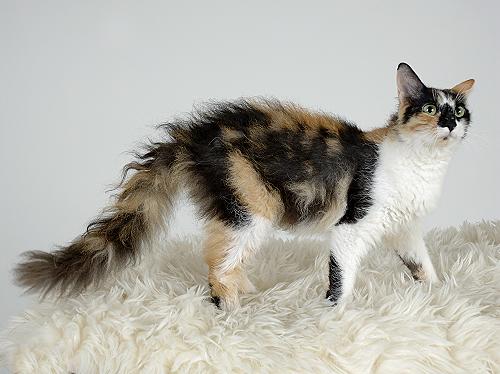
The LaPerm is a rex breed from the United States, named for a coat of waves, curls and ringlets that looks like a shaggy perm. The curl comes from a dominant gene and is not related to that of any other rex breed.
History
The breed started in the early 1980s with a natural mutation among farm cats owned by Linda and Richard Koehl of The Dalles, Oregon. Their cat Speedy had a curly-coated kitten, named Curly, and every LaPerm traces back to her. For about ten years the curly cats bred freely on the farm. Then the Koehls got in touch with cat fanciers and began a planned breeding program. The name follows a habit of the local Chinook trade language, which took French words together with their article, as in lapom for “apple”.
The LaPerm Society of America was formed in 1997. TICA granted championship status in 2003 and the CFA in May 2008. The first LaPerm reached the United Kingdom in May 2002, pregnant after a stay in the Netherlands, and her five kittens founded the British lines; the GCCF moved the breed from preliminary recognition in 2004 to full championship status in June 2012. FIFe gave full recognition in 2015. Breeders now work with LaPerms in many countries, among them Canada, Japan, Germany, the Netherlands, Sweden, Russia, South Africa, Australia and New Zealand.
Registries allow some outcrossing to keep the gene pool wide, mostly to ordinary domestic longhairs and shorthairs; the GCCF also permits a short list of pedigree breeds.
Appearance
Apart from its coat, the LaPerm is a moderate cat with nothing exaggerated about it. The body is medium-sized and muscular, with fairly long legs and neck. The head is a softly rounded wedge with a broad nose, flared ears and medium to large almond-shaped eyes.
The coat feels textured, a little like mohair, and not silky. It is loose and springy and stands away from the body. The tightest and longest curls are on the throat and ruff and at the base of the ears. Length and fullness change with the season and the cat’s age. There are longhaired and shorthaired LaPerms: longhairs have a curly plumed tail, shorthairs a tail more like a bottle brush and a slightly crisper coat. Both have long, curled whiskers.
Every color and pattern is accepted. Tabbies, reds and tortoiseshells are common, as they were among the farm cats the breed came from, and lilac, chocolate and colorpoint have been bred for since.
Temperament
LaPerms are affectionate, active and outgoing.
Care and health
The breed is often described as low-shedding and as less likely than other cats to set off allergies.
Facts on this page were checked against Wikipedia and may have changed since.