Cat breedsRex and curly-coated
Cornish Rex
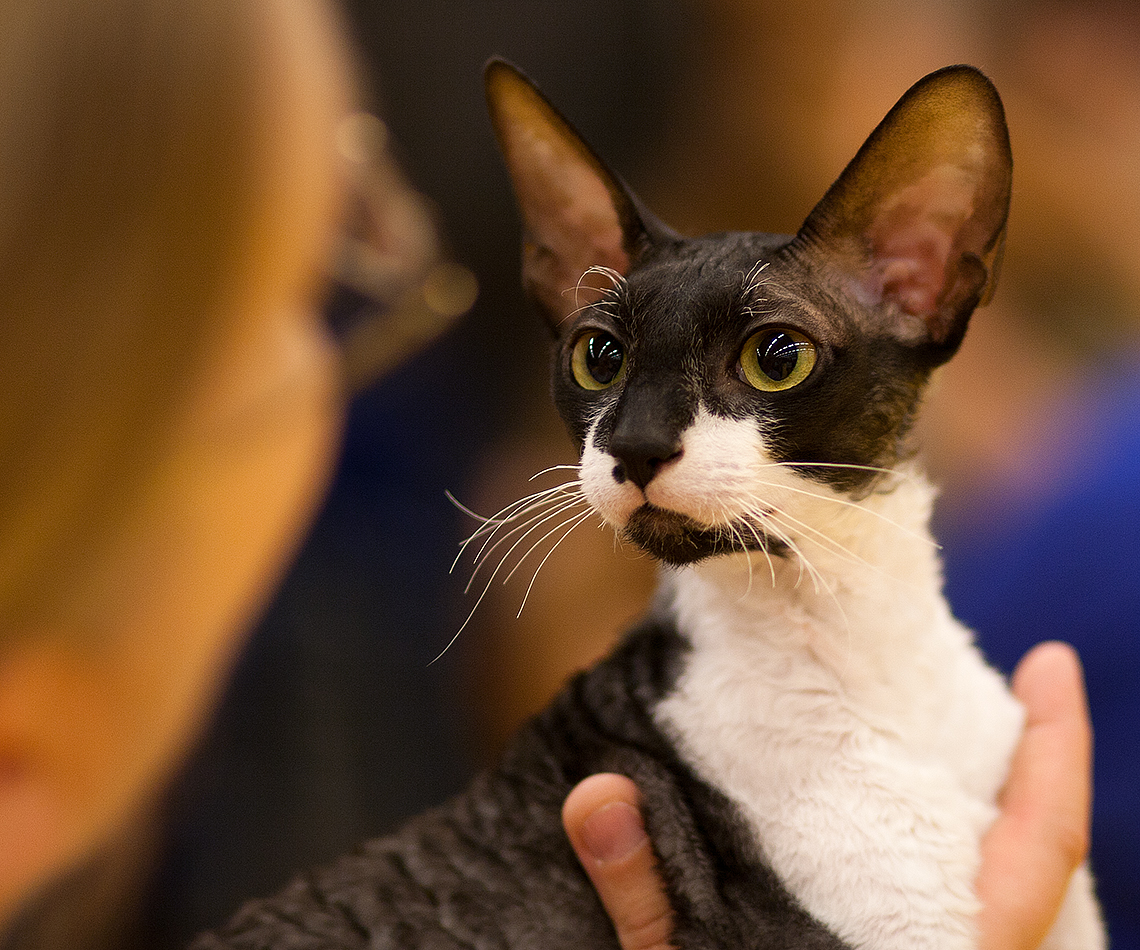

- Origin
- England
- Type
- Rex and curly-coated
- Coat
- Very fine, short and curly; down hair only
- Colors
- Any color
- Status
- Recognised by the CFA, TICA, FIFe and GCCF
The Cornish Rex is a domestic cat breed from Cornwall, in the southwest of England, known for a soft, tightly waved coat. Most cats have three kinds of hair: outer guard hairs, a middle layer of awn hairs and a fine undercoat of down about 1 cm long. The Cornish Rex has only the down.
History
The breed goes back to a litter born on a Cornish farm in the 1950s. One kitten, a cream male named Kallibunker, had an unusually fine, curly coat, the result of a spontaneous mutation. His owner mated him back to his mother, and two more curly kittens followed. One of them, a male called Poldhu, fathered a female named Lamorna Cove, who was later taken to America and crossed with a Siamese. That cross gave the breed its long, whip-like tail and big ears.
In 2013 researchers pinned down the mutation behind the coat: a small deletion in a gene called LPAR6, which helps keep the hair shaft intact. It was absent from every straight-haired cat they tested. The Devon Rex looks similar, but its curl comes from a different gene; the Devon has shortened guard hairs and sheds, while the Cornish has no guard hairs at all.
Appearance
Apart from its coat, the Cornish Rex stands out for its slim, muscular body, fine legs and tail, small paws and wedge-shaped head. The ears are large, wide at the base and rounded at the tip, often compared to a mussel shell. The eyes are oval and medium-sized and may be any color. The British standard treats coat color as irrelevant, so any color is allowed.
Its sleek outline and galloping run have earned it the nickname of the greyhound of the cat world.
Care and health
With so light a coat, the Cornish Rex feels the cold and does best indoors, where it is warm and dry.
The short coat does not make the breed hypoallergenic. Cat allergies are caused by a protein called Fel d 1, found in skin, saliva and urine, not by hair length, and the Cornish Rex grooms itself as much as any cat. It is nonetheless widely reported to set off milder reactions than other cats.
Facts on this page were checked against Wikipedia and may have changed since.