Cat breedsRex and curly-coated
German Rex
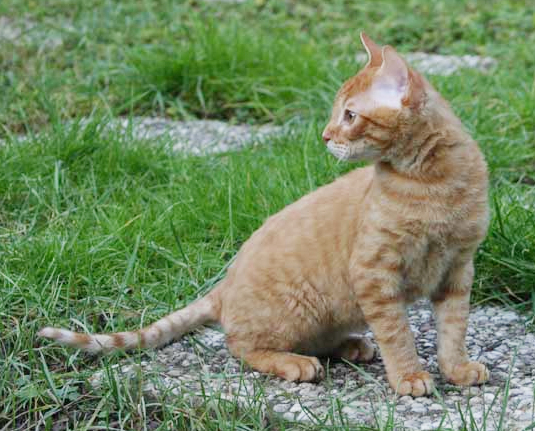

- Origin
- Germany
- Type
- Rex and curly-coated
- Size
- Medium
- Coat
- Short and silky, with a tendency to curl; curled whiskers
- Colors
- All colors
- Status
- Recognised by FIFe
The German Rex is a curly-coated breed of domestic cat from Germany. All of today’s German Rex trace back on the mother’s side to one cat, Lämmchen, found in Berlin after the Second World War.
History
An earlier curly cat is known from Germany: Munk, born in 1930 or 1931 in a village near Königsberg (now Kaliningrad) to the family of Erna Schneider. He was the son of a mahogany Angora and a Russian Blue and lived until 1944 or 1945. Researchers of the breed do not consider him an ancestor of the German Rex.
In the summer of 1951, Dr. Rose Scheuer-Karpin noticed a black curly-coated cat in the garden of the Hufeland hospital in Berlin-Buch. Staff said the cat had been around since 1947. The doctor named her Lämmchen, “little lamb”, and guessed correctly that her coat was the result of a mutation. In 1957 Lämmchen was mated to her straight-coated son Fridolin and had four kittens, two of them rex: the first German Rex bred on purpose. Lämmchen died in the 1960s, and her last kittens were born in 1962.
Many of her descendants went abroad and were used to strengthen other breeds, including the Cornish Rex. By 1968 the line depended on the East German vom Grund cattery, which took the last three rex offspring still in the country and widened the stock with European Shorthairs and mixed-breed cats. In 1973 the von Zeitz cattery established the breed in West Germany. Numbers grew slowly after that.
Appearance
The German Rex is medium-sized, with slender legs of medium length. It is heavier in build than the Cornish Rex and closer to a European Shorthair. The head is round, with well-developed cheeks and large, open ears. The eyes are medium-sized and match the coat in color.
The coat is short and silky and tends to curl. The whiskers curl too, though less than a Cornish Rex’s, and may be nearly straight. Every coat color is allowed, including white.
The curl comes from a recessive mutation on the same gene as in the Cornish Rex, so a kitten is curly only when it inherits the gene from both parents.
Temperament
The German Rex is very friendly and bonds quickly with its person. It is lively, playful and intelligent, much like the Cornish Rex in character.
Facts on this page were checked against Wikipedia and may have changed since.