Maine Coon

- Origin
- United States
- Type
- Longhair
- Size
- Large
- Weight
- 5–10 kg (12–22 lb)
- Coat
- Medium to long, soft and silky, shaggy and water-resistant, with a light undercoat
- Colors
- All colors; brown tabby is the most common
- Life span
- About 10–13 years
- Status
- Recognised by the CFA, TICA, FIFe and GCCF
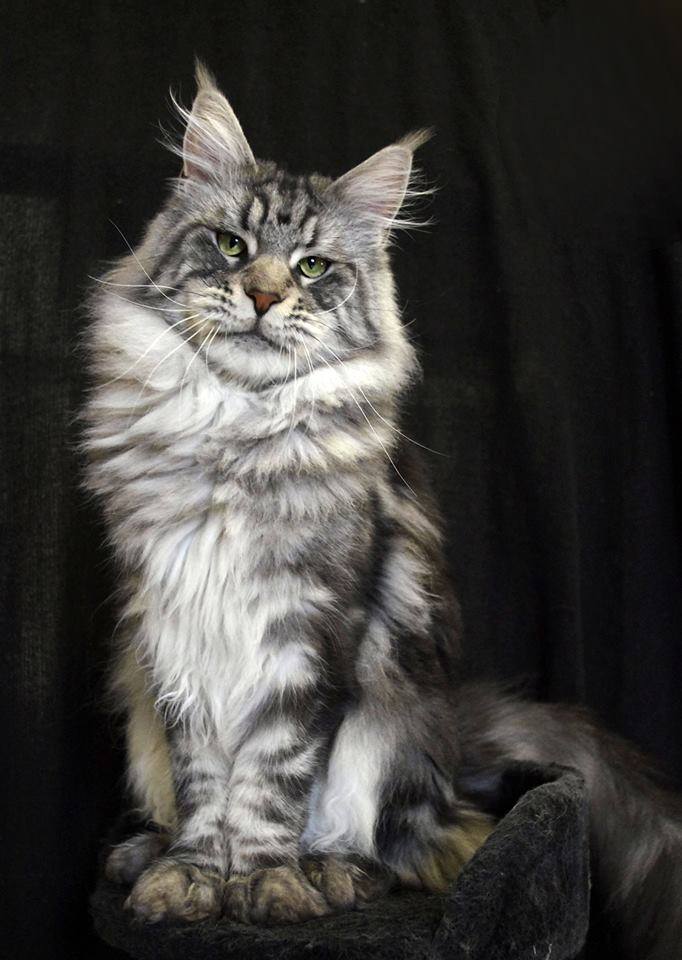
The Maine Coon is a large longhaired cat from the US state of Maine, where it is the official state cat. It was developed from one of the oldest landrace cats in North America and is registered by every major cat association. Its size and sociable nature have earned it the nickname “gentle giant”, and it is often said to behave rather like a dog.
History
Folk tales give the breed colorful origins: a cross with a raccoon or bobcat, descent from Viking ship’s cats, or longhaired cats shipped to Maine for Marie Antoinette. Genetic studies tell a plainer story. The Maine Coon descends from cats brought to New England by settlers from Britain in the 1600s and 1700s, and its closest relatives are the ordinary cats of the northeastern United States. It resembles the Norwegian Forest Cat and the Siberian because all three took shape in cold climates, not because they are closely related.
Maine farmers were showing their “coon cats” at the Skowhegan Fair in the 1860s. In 1895 a brown tabby Maine Coon named Cosey was Best in Show at Madison Square Garden in New York. Then Persians and other imported longhairs took over, and after 1911 the Maine Coon all but vanished from shows; in the 1950s it was even declared extinct, prematurely.
The Central Maine Cat Club, founded in the early 1950s, wrote the first breed standard. The CFA turned the breed down three times before granting provisional status in 1975 and championship status in 1976. In 2024 it was the most registered breed with FIFe, and in 2025 it took first place with the CFA.
Appearance
The Maine Coon is the largest domestic breed that is not a hybrid. Males average 8 to 10 kg (18–22 lb) and females 5 to 7 kg (12–15 lb). The body is rectangular, muscular and broad-chested, and the cat matures slowly, reaching full size at three to five years.
The coat is soft and silky, shorter on the head and shoulders and longer on the belly and flanks, often with a ruff at the neck. It is dense and water-resistant and thickens in winter. A long, bushy tail, large tufted paws that work like snowshoes, and heavily furred, tufted ears all suit a snowy climate.
Any color is possible, with brown tabby the most common.
Care and health
The coat needs less grooming than that of most longhaired breeds.
Extra toes (polydactyly) were common in the original Maine cats. The trait is harmless but was long barred from the show ring.
Health conditions recorded in the breed include hypertrophic cardiomyopathy, linked to a mutation in the MYBPC3 gene carried by about a third of cats tested at one laboratory; hip dysplasia, found in 24.3 percent of Maine Coons in one X-ray database; spinal muscular atrophy; and entropion, an inward-turning eyelid.
Figures for lifespan differ: Swedish insurance data gave a median above 12.5 years, while a UK study found a life expectancy of 9.71 years.
Facts on this page were checked against Wikipedia and may have changed since.