Persian
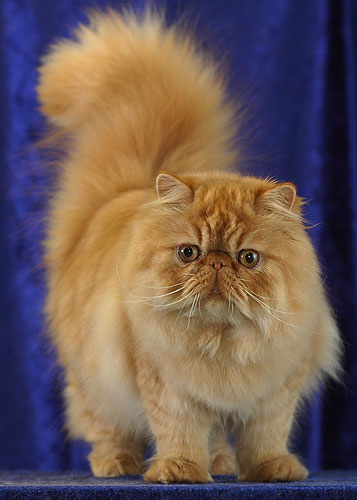

- Origin
- Iran
- Type
- Longhair
- Coat
- Very long and thick, with a woolly undercoat
- Colors
- Virtually every color and pattern
- Life span
- About 11–14 years
- Status
- Recognised by the CFA, TICA, FIFe, GCCF and WCF
The Persian, or Persian Longhair, is a longhaired breed with a round face, a short muzzle, a stocky body and a very full coat. It has been a fixture of cat shows since they began. Two types exist today: the traditional or “doll-face” Persian, with a small but distinct nose, and the modern show Persian, with a much flatter face.
History
Longhaired cats were reaching Europe from western Asia by the 17th century. The Italian traveler Pietro Della Valle wrote in 1620 of the gray longhaired cats of Khorasan and his wish to bring some to Italy. Firmer evidence comes from the 19th century, when longhaired cats were exported in numbers from Afghanistan and Iran. Modern Persians, however, are genetically closest to western European breeds such as the British Shorthair and Chartreux.
A Persian was shown at the first organised cat show, at the Crystal Palace in London in 1871, and Harrison Weir published the first standard in 1889, distinguishing the Persian from the Angora by its rounder head, fuller coat and longer tail.
In the late 1950s a mutation in red tabby Persians in the United States produced the flat “peke-face”. That variety faded, but breeders went on selecting for ever shorter faces, and the CFA standard now asks for forehead, nose and chin in a vertical line. Germany prohibits breeding cats whose nose tip sits above the lower eyelids.
The Himalayan, a colorpoint created by crossing with Siamese from 1950, and the Exotic Shorthair, from crosses with American Shorthairs, are treated by some registries as varieties of the Persian and by others as separate breeds.
Appearance
The standard describes a cat in which everything is round: a broad, rounded head, large round eyes set wide apart, and small ears set far apart. The body is short and cobby with a broad chest and short, sturdy legs. The coat is extremely long and thick, with a woolly undercoat beneath long outer hair. Almost every color and pattern is accepted, and eye color varies with the coat, including blue, copper, green and odd eyes.
Temperament
Persians are generally quiet, placid cats that adapt well to apartment life. In one study their owners rated them higher than non-pedigree cats for affection, friendliness to strangers and cleanliness.
Care and health
The coat is more than the cat can keep clean on its own; it needs frequent brushing to prevent mats, and the eyes may need regular cleaning to prevent tear stains.
The flat face of the modern type can cause breathing difficulty, overflowing tears, inward-turning eyelids, corneal problems, crowded teeth, skin-fold dermatitis and difficult births. Polycystic kidney disease, caused by a dominant mutation in the PKD1 gene, has been found in 36 to 49 percent of Persians in various studies; a DNA test lets breeders avoid it. Other conditions noted in the breed include hypertrophic cardiomyopathy, progressive retinal atrophy, hip dysplasia and ringworm. White Persians, especially blue-eyed ones, are prone to deafness.
Lifespan studies give figures from about 11 years (UK, 2024) to 14 years (England, 2015).
Facts on this page were checked against Wikipedia and may have changed since.