Siberian

- Origin
- Russia
- Type
- Longhair
- Size
- Large
- Weight
- 4.5–9 kg (10–20 lb)
- Coat
- Semi-long to long, very dense triple coat with water-repellent guard hairs
- Colors
- Most colors and patterns; brown mackerel tabby is the most common
- Status
- Recognised by the CFA, TICA, FIFe, GCCF and WCF
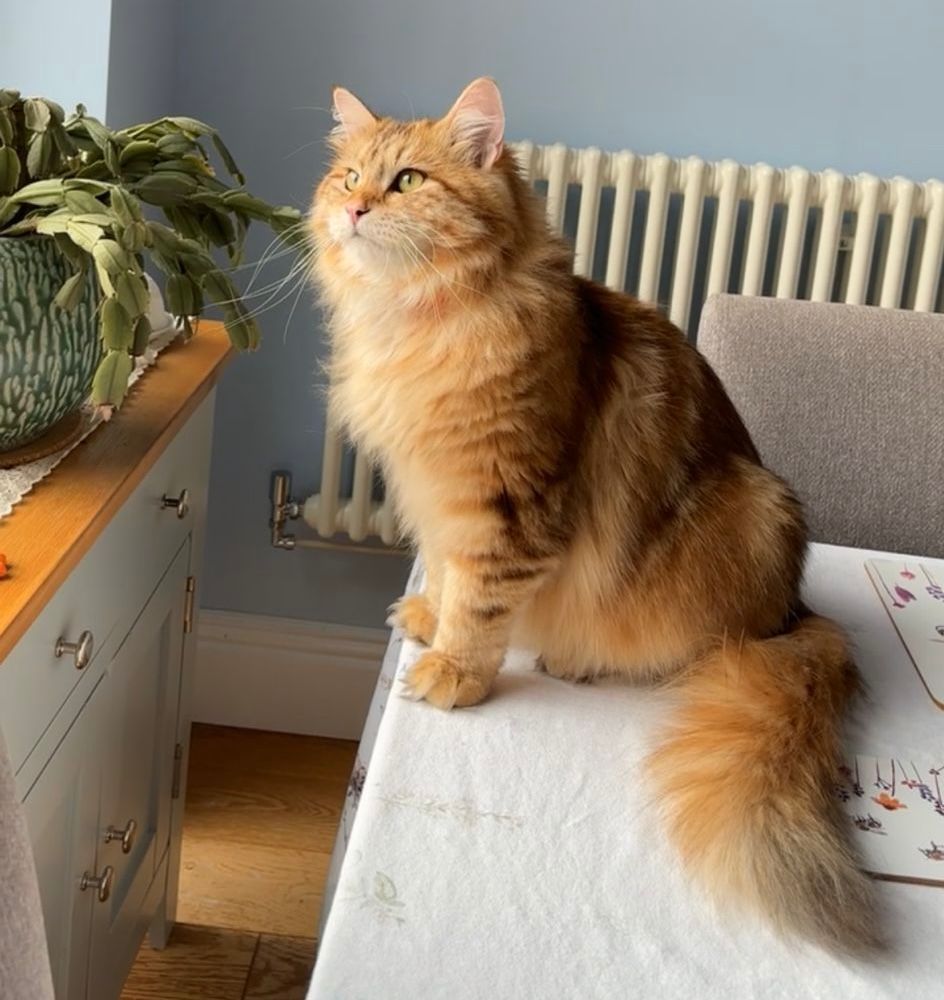
The Siberian, formally the Siberian Forest Cat, comes from a natural variety of cat that has lived in Russia for centuries. It has been bred to a written standard only since the late 1980s. It is Russia’s national cat, a medium to large, muscular animal with a bushy tail. Its colorpoint form, the Neva Masquerade, is counted as a separate breed by some registries, including FIFe and the WCF.
History
Long-haired forest cats appear in Slavic folktales, country lore and art going back to the 10th century. Outside Russia, a Siberian cat was mentioned in a German natural history book in 1864, and Harrison Weir described the “Russian Long-haired Cat” in 1889. Those early imports were crossed with other longhairs and lost their identity.
The modern breed dates from the end of the Soviet period. In 1987 a young pair was taken from St. Petersburg to Berlin and a breeding program was started; the same year the Kotofei Cat Club in St. Petersburg published one of the first standards. Registered Siberians reached the United States in 1990 and Britain in 2002. The WCF accepted a standard in 1991, TICA gave championship status in 1996, FIFe recognised the breed in 1997, the GCCF in 2004, and the CFA granted championship status in 2006. Its popularity rose sharply from the mid-2010s.
Siberians are closely related to Norwegian Forest cats. Their likeness to the Maine Coon comes from adapting to a similar climate, not from shared ancestry.
Appearance
Everything about the Siberian is rounded: a barrel-shaped body, large round paws, a broad round face with a short muzzle, and big round eyes. The ears are medium-sized with rounded tips. The legs are heavy-boned and fairly short, with the hind legs a little longer than the front. Females are much smaller than males. The cats mature slowly and are not fully grown until about five years old.
The coat has three layers, guard hair, awn hair and down, and the guard hairs shed water. It is shorter in summer than in winter. All the “Western” colors and patterns are found, with or without white, silver or gold; chocolate, lilac, cinnamon and fawn are not permitted.
Temperament
Siberians are playful and adventurous but also friendly and easygoing. They are affectionate and loyal, often compared to dogs, and some learn to fetch. They like to take part in whatever the household is doing, and many are drawn to water. They are talkative in a quiet way, with chirps and a deep purr, and they are strong jumpers.
Care and health
The coat needs grooming several times a week to keep it from matting. There is a heavy molt in spring and often a lighter one at the end of summer.
The breed is relatively healthy and has the greatest genetic variety of any pedigree cat. In a large study, injury was the commonest problem, put down to the breed’s energy. Solid white, blue-eyed cats are more often deaf. Siberians are often called hypoallergenic. Tests have found that about half produce less of the main cat allergen, Fel d 1, than other breeds, but every Siberian tested produced some.
Facts on this page were checked against Wikipedia and may have changed since.