Burmilla

- Origin
- United Kingdom
- Type
- Shorthair
- Size
- Medium
- Weight
- 3–6 kg (7–13 lb)
- Coat
- Short and close-lying with a silky feel; a semi-longhaired form also exists
- Colors
- Silver or golden, shaded or tipped with black, blue, brown, chocolate or lilac
- Status
- Recognised by the GCCF, FIFe and the CFA
The Burmilla is a British breed that came from a cross between a Chinchilla Persian and a Burmese, and its name joins the two. Some registries place it in the Asian group of breeds, where it may be called the Asian Shaded.
History
The first Burmillas were an accident. In the cattery of Miranda von Kirchberg, a Chinchilla Persian named Jamari Sanquist and a lilac Burmese named Bambino Lilac Fabergé were being kept in separate rooms, each waiting for a mate, when a cleaner left a door open one night. Four kittens were born in 1981, all of them shorthaired, silver-shaded females: Galatea, Gemma, Gabriela and Gisella.
Von Kirchberg liked the look of the litter and showed it to a fellow breeder, Therese Clarke. The two decided to build a breed from it. Clarke took Gemma and von Kirchberg kept Galatea, and these two cats founded the first lines. Clarke set up the Burmilla Cat Club in 1984, the year standards were drawn up. The Cat Association of Britain recognised the breed in 1994, and the Governing Council of the Cat Fancy accepted it for championship in 1995.
In Australia one body uses the name Australian Tiffanie for what is in effect a longhaired Burmilla with a larger share of Chinchilla Persian. The name has not been taken up internationally and is falling out of use.
Appearance
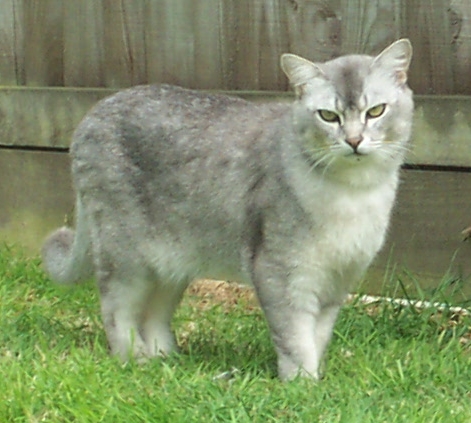
The Burmilla is a medium-sized, muscular and elegant cat, usually weighing 3 to 6 kg. The head is gently rounded on top and narrows to a short, blunt wedge, with a slight break in the line of the nose. The ears are medium to large with slightly rounded tips and tilt a little forward. The eyes are large, set well apart and green, though young cats may show a yellowish tinge. Dark outlines around the eyes, nose and lips look like make-up.
Most Burmillas are shorthaired, with a close-lying coat like a Burmese but with an undercoat that makes it feel soft and slightly padded. A recessive gene from the Persian side can produce semi-longhaired cats with a plumed tail; the GCCF calls these Tiffanies.
The coat is tipped or shaded. In a tipped cat only the last eighth to quarter of each hair is colored, so a silver cat can look almost white. In a shaded cat a quarter to half of the hair is colored, giving a mantle over the back, shoulders and outer legs. The color may be black, blue, brown, chocolate or lilac; red, cream and tortoiseshell have also been bred. Most registries accept only silver cats, while FIFe and the Australian Cat Federation also accept golden ones. Smoke-patterned cats are not counted as Burmillas.
Temperament
Burmillas are described as sociable, playful and affectionate, with an independent streak, and they keep kitten-like ways into adult life. They are attached to their owners and usually get on well with children and other animals.
Facts on this page were checked against Wikipedia and may have changed since.