Australian Mist
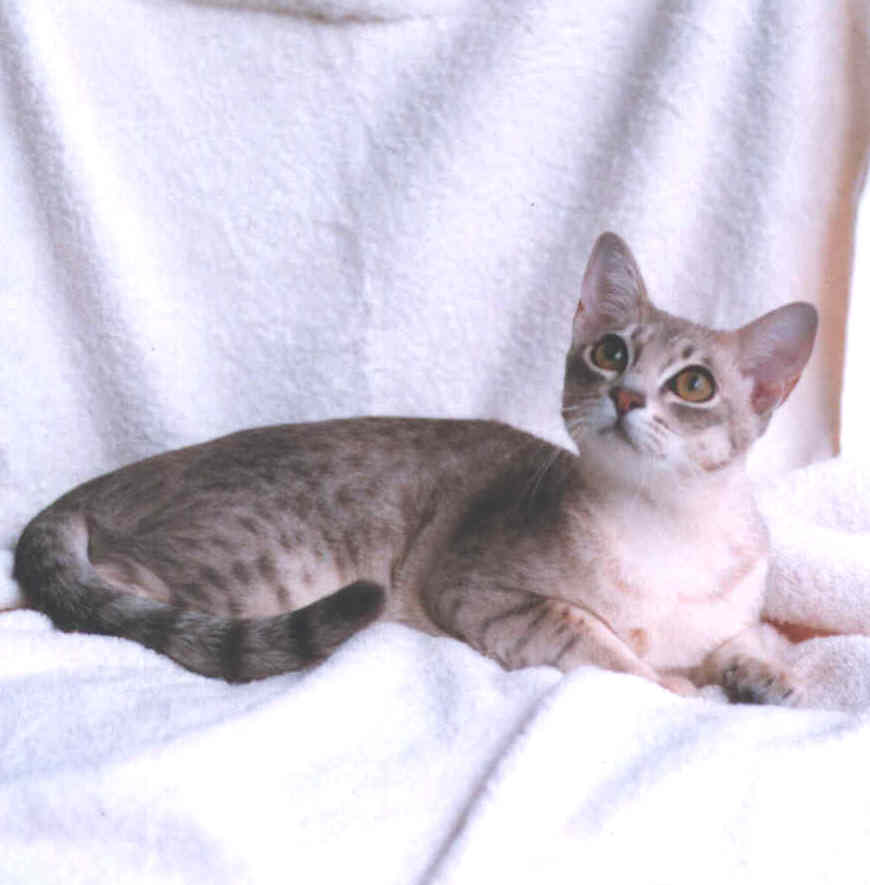

- Origin
- Australia
- Type
- Shorthair
- Size
- Medium
- Coat
- Short to medium, smooth and silky
- Colors
- Brown, blue, chocolate, lilac, gold, peach and caramel, in spotted or marbled tabby
- Status
- Recognised by TICA, the GCCF and the WCF; not recognised by FIFe
The Australian Mist is a shorthaired breed developed in Australia from Burmese, Abyssinian and ordinary domestic spotted tabby cats. It takes its name from its coat, whose spotted or marbled markings look softened, as if seen through a fine veil. It was first called the Spotted Mist.
History
Dr. Truda Straede began the breed in 1977, working from about 30 foundation cats, after putting a plan to the Royal Agricultural Society of New South Wales Cat Club. The idea was to combine the sepia coloring of the Burmese with the ticked hairs of the Abyssinian and the pattern of a spotted tabby.
The club accepted the first generation as experimental in May 1980 and the fourth generation, under the name Spotted Mist, in April 1986. A marbled variety was accepted in June 1997. Since the cats were no longer all spotted, Australia’s cat bodies agreed unanimously to rename the breed the Australian Mist.
Recognition abroad followed. The New Zealand Cat Fancy gave it championship status at the start of 1999 and the World Cat Federation in August 2004. The first cats reached the United Kingdom in 2007; the Governing Council of the Cat Fancy granted preliminary recognition in 2011 and championship status in February 2017. The International Cat Association accepted the breed for championship on 1 May 2014. FIFe does not yet recognise it. Most breeders are still in Australia, with a few in the United Kingdom and the United States, and breeding cats have also gone to Norway.
Appearance
The Australian Mist is a medium-sized cat with a rounded head, a broad nose, fairly large ears with rounded tips and large eyes in any shade of green, from chartreuse to aquamarine. The coat is short to medium in length and feels smooth and silky.
Three things make up the coat: a pale ground color, a darker tabby pattern over it, and scattered ticking that gives the misted look. The pattern is either spotted, with distinct, symmetrical spots, or marbled, with swirls and streaks. In both, the legs and tail are ringed or barred, the tail ends in a dark tip, lines of color mark the face and neck, and the forehead carries the tabby M. The underparts are paler than the rest.
The accepted colors are brown, blue, chocolate, lilac, gold, peach and caramel. Red-based colors are not allowed by any registry. The full color may take two years or more to develop.
Care and health
Breeding cats are commonly screened for pyruvate kinase deficiency, feline hypokalemic polymyopathy, neonatal isoerythrolysis and progressive retinal atrophy.
Facts on this page were checked against Wikipedia and may have changed since.