Burmese
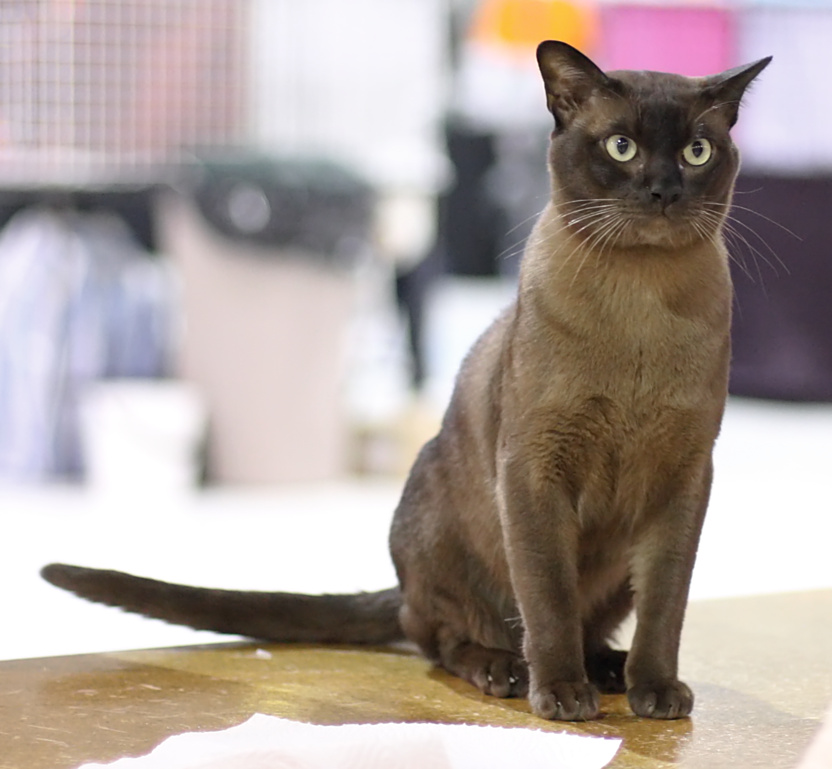

- Origin
- Burma
- Type
- Shorthair
- Size
- Medium
- Weight
- 4–6 kg (9–13 lb)
- Coat
- Very short, fine and glossy, with a satin finish
- Colors
- Originally dark brown (sable); also blue, chocolate, lilac, red, cream and tortoiseshell
- Life span
- About 14 years
- Status
- Recognised by the CFA, TICA, FIFe, GCCF and WCF
The Burmese is a pedigreed house cat whose roots are thought to lie near the border of Burma and Thailand. The breed as it exists today was shaped by breeders in the United States and Britain, and nearly all modern Burmese trace back to a single female, Wong Mau, who was brought from Burma to America in 1930.
History
In 1930 Joseph Cheesman Thompson brought Wong Mau, a dark brown female, to San Francisco. He thought her build was different enough from the Siamese to found a breed. She was mated to a seal point Siamese named Tai Mau and then to one of her sons, and the dark brown kittens that followed became the foundation stock. It later turned out that Wong Mau was herself a cross between the Siamese and Burmese types, the mix now bred as the Tonkinese.
The Cat Fanciers’ Association recognised the Burmese in 1936, suspended recognition about ten years later because so much Siamese blood had been added, and restored it in 1954. Britain started its own program, and the Governing Council of the Cat Fancy recognised the breed in 1952. Most Commonwealth and European countries imported British cats and follow the British standard. The registries that treat the two as separate breeds call the British type the European Burmese.
Appearance
The two standards differ mostly in the head and body. The British, or traditional, Burmese is the more slender cat, with a wedge-shaped head, large pointed ears, a longer muzzle, slightly almond-shaped eyes, long legs and oval paws. The American, or contemporary, Burmese is stockier, with a broad head, round eyes, a short flattened muzzle and rounded paws.
Both are small to medium cats that are surprisingly heavy for their size, a quality summed up in the phrase “a brick wrapped in silk”. The coat is very short, fine and glossy. The color is solid and even, shading gently to a lighter underside, and the eyes are gold or green depending on the coat. The original color is a rich dark brown called sable in the United States, brown in Britain and seal in New Zealand. Blue, chocolate, lilac, red, cream and tortoiseshell came later, and which colors are accepted depends on the registry.
Temperament
Burmese are strongly attached to people and stay playful and energetic as adults. They are often compared to puppies: they follow household activity, bond closely with their owners and many learn to fetch. They are persistent talkers, like the Siamese, but with a softer voice. They do not do well when left alone for long stretches.
Care and health
A study of British veterinary records found an average life expectancy of about 14.4 years, the highest of the breeds examined. Studies in England and Australia found diabetes mellitus more common in Burmese than in cats overall. The breed is also the one most often affected by feline orofacial pain syndrome and by hypokalaemia. In the American lines, a mutation linked to the short face causes a fatal head defect in kittens that inherit two copies.
Facts on this page were checked against Wikipedia and may have changed since.