Cat breedsBobtail and tailless
Highlander
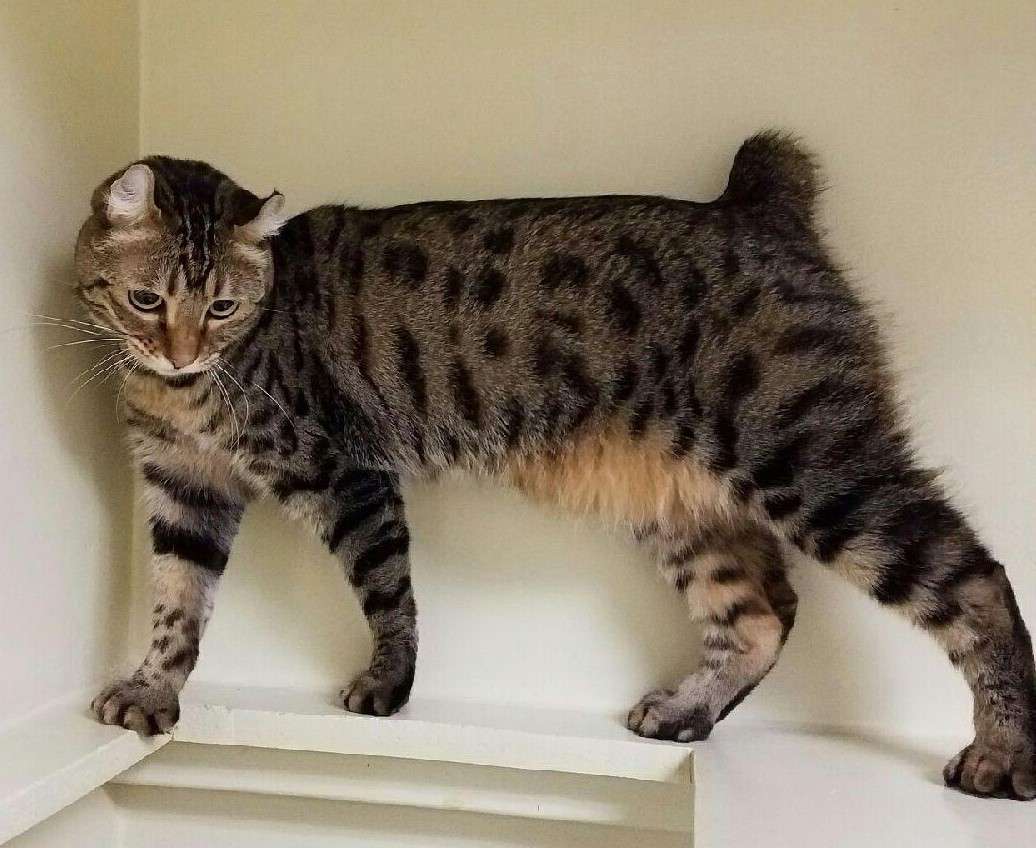

- Type
- Bobtail and tailless
- Size
- Large
- Weight
- 4.5–9.1 kg (10–20 lb)
- Coat
- Short, or longer in the longhaired variety
- Colors
- Tabby, lynx point or solid point in various colors; no bicolors
- Status
- Recognised by TICA and the ACFA
The Highlander is a recently developed breed with a bobbed tail and curled ears. It began as a deliberate cross between two other new breeds, the experimental Desert Lynx and the Jungle Curl, made in order to add the Jungle Curl’s ears to the Desert Lynx. It was first known as the Highland Lynx.
History
Work to refine the breed began in 2004, with the aims of setting it apart from the cats it was founded on and of winning show status with the major registries. The name Highlander was adopted late in 2005, and the older name Highland Lynx is no longer used for the breed.
TICA accepted the Highlander into its Preliminary New Breed class from May 1, 2008, and moved it up to Advanced New Breed in 2016. TICA divides the breed into two varieties, the Highlander Shorthair and the longer-coated cat called simply the Highlander. The American Cat Fanciers Association accepted the breed for championship competition in 2022. As of May 2025 both varieties are reported to hold championship status in TICA, the ACFA and two smaller registries.
Appearance
The Highlander is built to look something like a bobcat. Its body is substantial and very muscular, and its tail is bobbed or short. The forehead is long and sloping, the muzzle blunt and the nose very wide. The eyes are set wide apart. The ears stand upright, with a slight curl and a slight backward turn.
Females grow to between 4.5 and 6.4 kg (10 and 14 lb), and males to between 6.8 and 9.1 kg (15 and 20 lb). Coats are spotted, mackerel or classic tabby with a bullseye marking, and the breed comes in tabby, lynx point and solid point colorings in various colors. Bicolored cats are not allowed by the standard. Some Highlanders are born with extra toes, but this is not part of the standard and disqualifies a cat in the show ring.
Temperament
In spite of its wild look, the Highlander is described as friendly, playful and fond of people, and as a very active and confident cat.
Facts on this page were checked against Wikipedia and may have changed since.