Chinese Mountain Cat
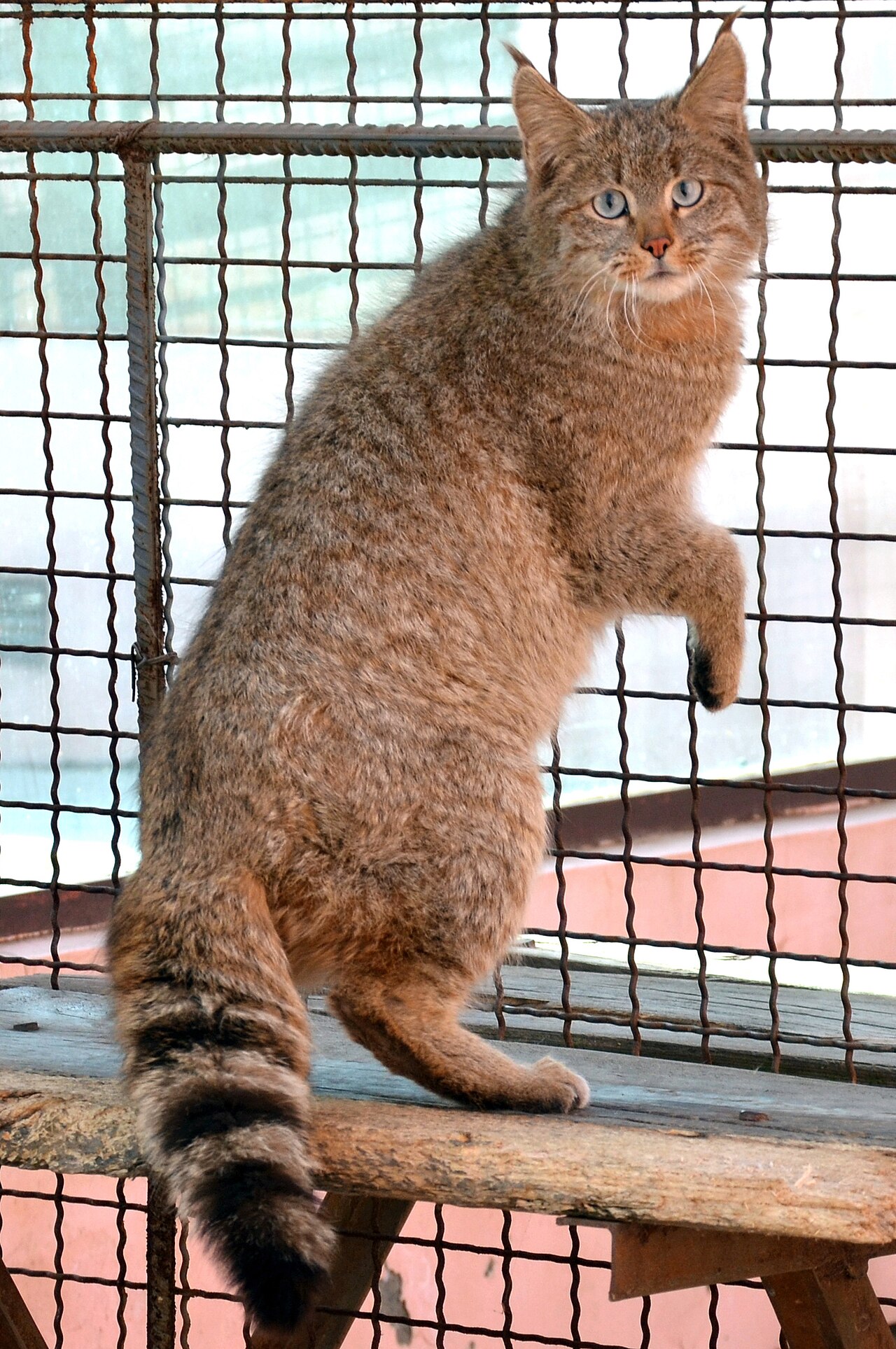

- Origin
- China
- Type
- Wild cat
- Weight
- 6.5–9 kg (14–20 lb)
- Colors
- Sand-colored with faint dark stripes, black-tipped ears and a ringed tail
- Status
- Vulnerable (IUCN)
The Chinese mountain cat (Felis bieti) is a small wild cat that lives only in China, on the north-eastern edge of the Tibetan Plateau. It is also called the Chinese desert cat or Chinese steppe cat, although it has never been confirmed in true desert. It has been listed as Vulnerable on the IUCN Red List since 2002.
The species was named in 1892 by Alphonse Milne-Edwards from a skin collected in Sichuan Province; the name honors the French missionary Félix Biet. In 2007 it was provisionally treated as a subspecies of the wildcat, but since 2017 it has been recognised as a species in its own right. Its lineage is estimated to have shared an ancestor with the Asiatic wildcat about 1.5 million years ago.
Range and habitat
The cat has been recorded only in eastern Qinghai and north-western Sichuan. It lives at 2,500–5,000 m (8,200–16,400 ft) in high steppe grassland, alpine meadow, alpine shrubland and along the edges of conifer forest. It has not been confirmed in heavily forested mountains. The first photographs of a wild Chinese mountain cat were taken only in 2007, and camera traps and field surveys have recorded it at several sites on the plateau since.
Appearance
The fur is sand-colored with dark guard hairs, and whitish on the belly. Faint dark stripes cross the face and legs but are hard to make out. The ears have black tips, the legs and tail carry black rings, and the tail ends in black. The skull is fairly broad, and long hair grows between the pads of the feet. Head and body measure 69–84 cm (27–33 in), with a tail of 29–41 cm (11–16 in). Adults weigh 6.5 to 9 kg (14 to 20 lb).
Behavior
Chinese mountain cats hunt pikas, rodents and birds. Ten cats followed in the Qilian Mountains in 2020 and 2021 were active throughout the day, most of all from late afternoon into the early night.
Breeding takes place between January and March. The female has two to four kittens in a hidden burrow, usually an old marmot or badger den on a south-facing slope. The cats have been seen killing marmots and then moving into their burrows.
Conservation
The main threat is the organised poisoning of pikas, which removes the cats’ prey and also kills cats by accident. The species is on CITES Appendix II and is protected by Chinese law; since February 2021 it has been a National First-Class Protected Animal. Some genes passed from Chinese mountain cats into house cats in parts of the Tibetan Plateau between the 1960s and 2000s.
Facts on this page were checked against Wikipedia and may have changed since.