Cat breedsType or coat pattern
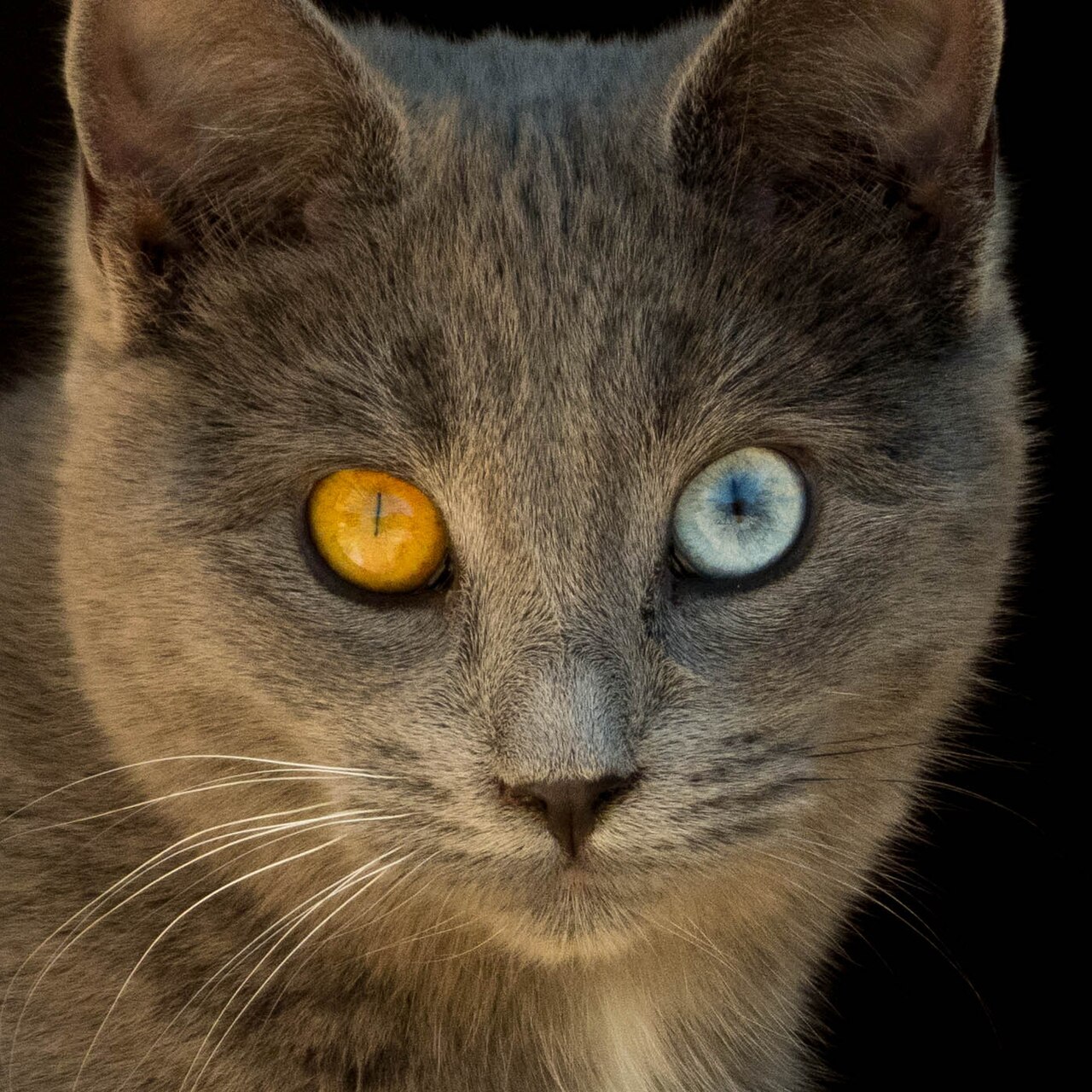
Odd-eyed cat

- Type
- Type or coat pattern
- Colors
- Most often solid white, but found with any coat color
An odd-eyed cat has one blue eye and one eye of another color: green, yellow, amber or brown. This is not a breed but a trait, the feline form of complete heterochromia, which also occurs in other animals and in people. A related form, sectoral heterochromia, shows two colors within a single iris. Odd eyes are most common in solid white cats but can appear with any coat color.
How it happens
Odd eyes usually arise when a gene for white fur stops pigment from developing in one eye. The genes involved are the ones that turn a cat solid white and the white spotting gene responsible for bicolor coats. Roughly 15 to 40 percent of solid white cats have one or two blue eyes.
Much more rarely, odd eyes appear in cats with neither of those genes. Such cats carry a dominant blue-eye gene that has nothing to do with coat color, as in the extinct Ojos Azules.
All kittens start out with blue eyes. In an odd-eyed kitten each eye is a slightly different blue, and the difference is easy to miss. Over some months one eye changes, passing through other shades, until it settles on its adult color.
Breeds
Odd eyes can turn up in any domestic cat and belong to no one breed. They are especially popular in the Van cat, Turkish Van, Turkish Angora, Sphynx, Persian, Oriental Shorthair, Japanese Bobtail and Khao Manee. In the Japanese Bobtail they are seen most often in calico cats.
Care and health
It is often said that every odd-eyed cat is deaf in one ear. That is not true, but solid white cats with one or two blue eyes do have a higher rate of inherited deafness, because the white gene can cause the cochlea to break down a few days after birth. In an odd-eyed white cat the deaf ear, if there is one, tends to be on the side of the blue eye.
By one estimate, 10 to 20 percent of solid white cats without blue eyes are deaf, compared with 30 to 40 percent of odd-eyed whites and 60 to 80 percent of whites with two blue eyes; a cat counts as deaf here if one or both ears are affected. Blue eyes that come from other genes, such as the Siamese colorpoint gene, are not linked to deafness. Hearing in cats is checked with the BAER test.
Folklore
Odd-eyed white cats are prized in Turkey. The Atatürk Forest Farm and Zoo in Ankara has bred white Turkish Angoras and particularly valued the odd-eyed ones; a Turkish saying has it that the eyes should be as green as the lake and as blue as the sky. Muezza, the Prophet Muhammad’s cat, is reputed to have been odd-eyed, and the mascot of the 2010 basketball world championship in Turkey was an odd-eyed Van cat called Bascat.
Facts on this page were checked against Wikipedia and may have changed since.