Cat breedsType or coat pattern
Polydactyl cat
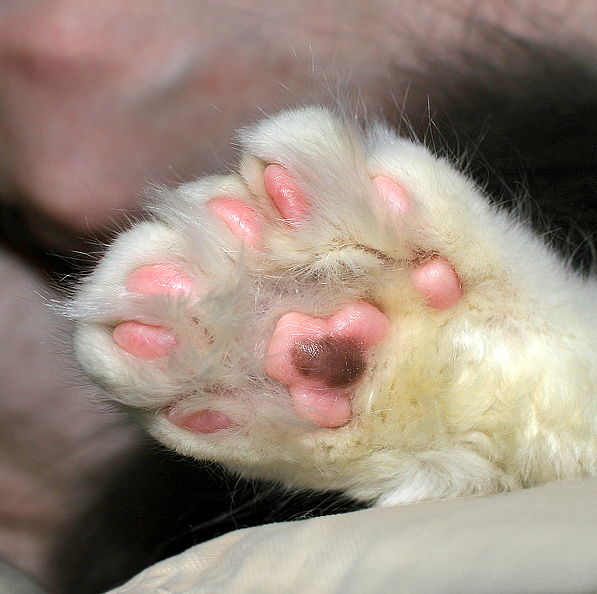

- Type
- Type or coat pattern
- Status
- Barred from showing by the CFA, FIFe, GCCF and WCF; allowed by TICA in a few breeds
A polydactyl cat is not a breed. It is any cat born with more than the usual number of toes on one or more paws, a harmless inherited trait known as polydactyly. Such cats are most common along the East Coast of the United States and Canada, and in southwest England and Wales.
The extra toes
An ordinary cat has 18 toes, five on each front paw and four on each hind paw. Polydactyl cats commonly have anywhere from four to seven on a paw. The extra toes usually appear on the front paws only. Extra toes on the hind paws alone are rare, and on all four paws rarer still. The record belongs to Erebus, a cat from Wisconsin with 29 toes.
In most cases the additional toes grow on the inner, thumb side of the paw and are fully formed, with their own nerves, blood vessels, muscles and ligaments. Extra toes on the outer side are much less common and often incomplete.
The trait is usually dominant, so a kitten needs to inherit it from only one parent. It comes from a change in a stretch of DNA that controls a gene involved in shaping the limbs before birth. Several different mutations in the same region produce extra toes. Even among cats that carry the very same mutation, the number of extra toes varies.
History
There is some argument over whether the common form arose in New England or was carried there from Britain. It is generally agreed that it spread on ships sailing from Boston. How common polydactyl cats are in North American ports matches how early each port began trading with that city. Sailors valued the cats as climbers and hunters of shipboard rats and mice, and some thought they brought good luck at sea.
The writer Ernest Hemingway was given a six-toed cat named Snow White by a ship’s captain and became devoted to them. His former home in Key West, Florida, is now a museum that houses about 50 descendants of his cats, roughly half of them polydactyl. The nickname “Hemingway cat” comes from him.
Breeding and showing
Extra toes turn up in ordinary random-bred cats and say nothing about pedigree. Most breed standards treat them as a disqualifying fault. FIFe, the GCCF, the CFA and the WCF bar polydactyl cats from registration and showing on welfare grounds, arguing that the extra toes bring no benefit and may be prone to injury. TICA allows them in a few breeds, including the Highlander, the Pixie-bob and the Maine Coon, whose polydactyl form may have no more than seven toes on a foot.
Care and health
Polydactyly does not shorten a cat’s life or cause illness. Claws on the extra toes may not wear down by themselves, so they should be trimmed regularly to keep them from curling into the paw. Cats with extra toes, kittens especially, are also more likely to get a claw caught.
Facts on this page were checked against Wikipedia and may have changed since.