Cat breedsType or coat pattern
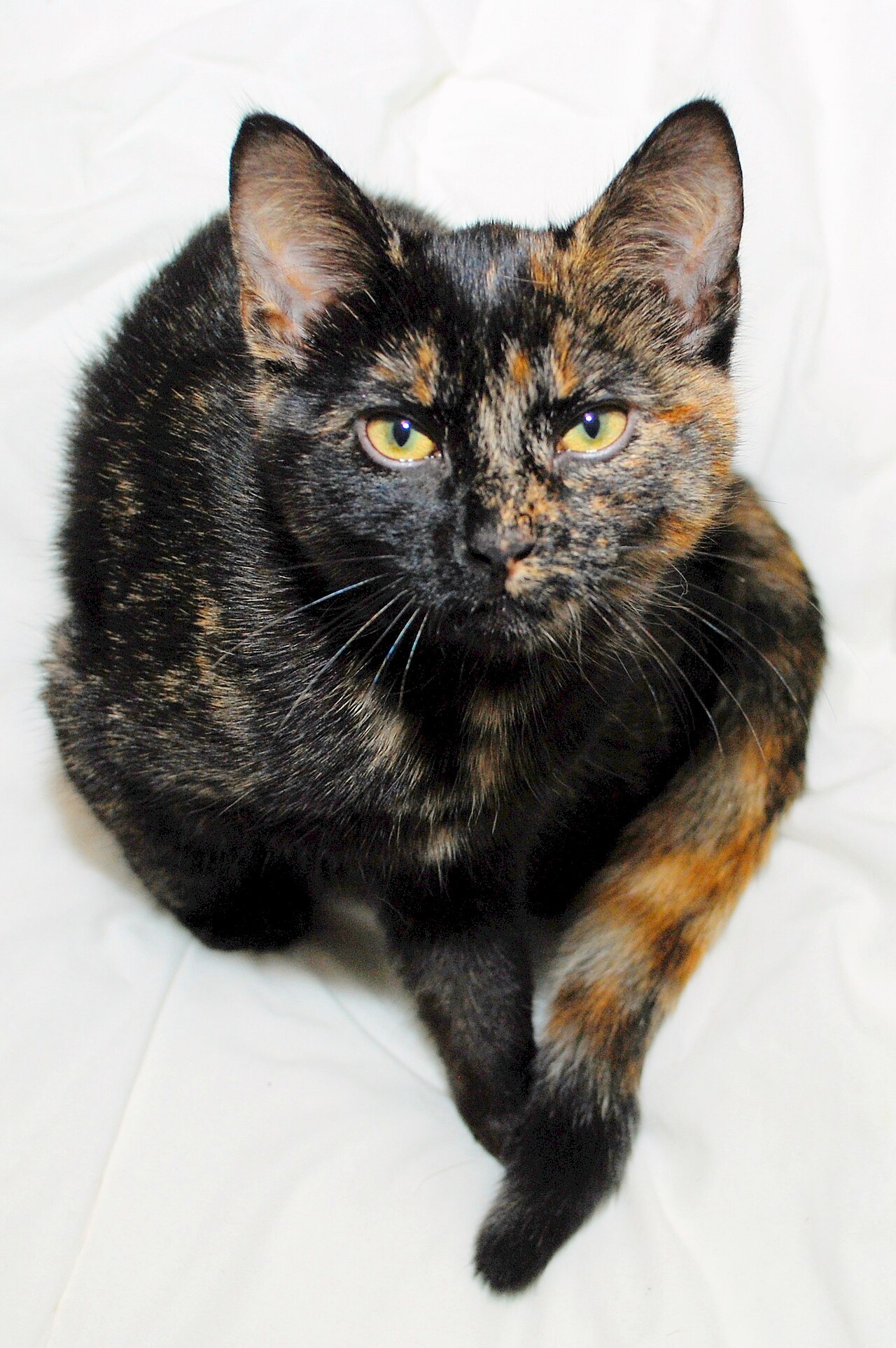
Tortoiseshell cat

- Type
- Type or coat pattern
- Colors
- Black and red most often; also blue and cream and other pairings, brindled or in patches
Tortoiseshell is a coat coloring, not a breed. A tortoiseshell cat, or tortie, has a coat of two colors other than white, spread unevenly over the body, either finely mixed (“brindled”) or in larger patches. The name comes from its likeness to tortoiseshell material. The coloring turns up in many breeds and in ordinary non-pedigree cats, and it is especially prized in the Japanese Bobtail.
Appearance
One of the two colors is always from the black family (black, blue, chocolate, lilac, cinnamon or fawn) and the other from the red family (red or cream). Black and red is by far the most common combination. A dilution gene softens the colors, turning black to blue and red to cream, so a “dilute” tortie is typically blue and cream. In everyday speech blue is often called gray, and red is called orange or ginger.
The markings are asymmetrical, and the patches can be anything from a fine speckle to broad areas of color.
Several variations have their own names. A tortoiseshell with tabby striping in its dark areas is a tortoiseshell tabby, or torbie. A tortoiseshell with white is a tortoiseshell-and-white, known in North America as a calico. The gene for white spotting slows the spread of pigment cells in the embryo, with the result that the more white a cat has, the larger and more sharply separated its colored patches are. The coloring can also be confined to the points of a colorpoint cat, giving a tortie point.
Why torties are female
The gene that decides between orange and non-orange pigment sits on the X chromosome. A female has two X chromosomes, and early in development one of them is switched off at random in each cell. If she carries the orange version on one X and the non-orange on the other, some patches of skin grow orange fur and others black, and she is a tortoiseshell. A male has a single X, so he is normally one or the other.
The geneticist Leonard Doncaster was the first to show that the coloring is sex-linked. About one tortoiseshell in 3,000 is male. Most such males have an extra X chromosome (XXY) and are usually sterile; a few are chimeras, formed from two embryos fused early in development, or mosaics.
Temperament
Many people believe torties are feistier than other cats, and the slang word “tortitude” was coined for this supposed trait. There is little scientific evidence for it. One study found no link between coat color and tameness, and the research so far does not support judging a cat’s personality by its color.
Folklore
Tortoiseshell cats are considered lucky in several cultures. In Ireland they are said to bring good fortune to their owners, in the United States they are sometimes called money cats, and in Japan they were thought to protect against shipwreck. English tradition is less cheerful: a strange tortoiseshell coming into the house was taken as a sign of misfortune.
Facts on this page were checked against Wikipedia and may have changed since.