Cat breedsType or coat pattern
Dwarf Cat
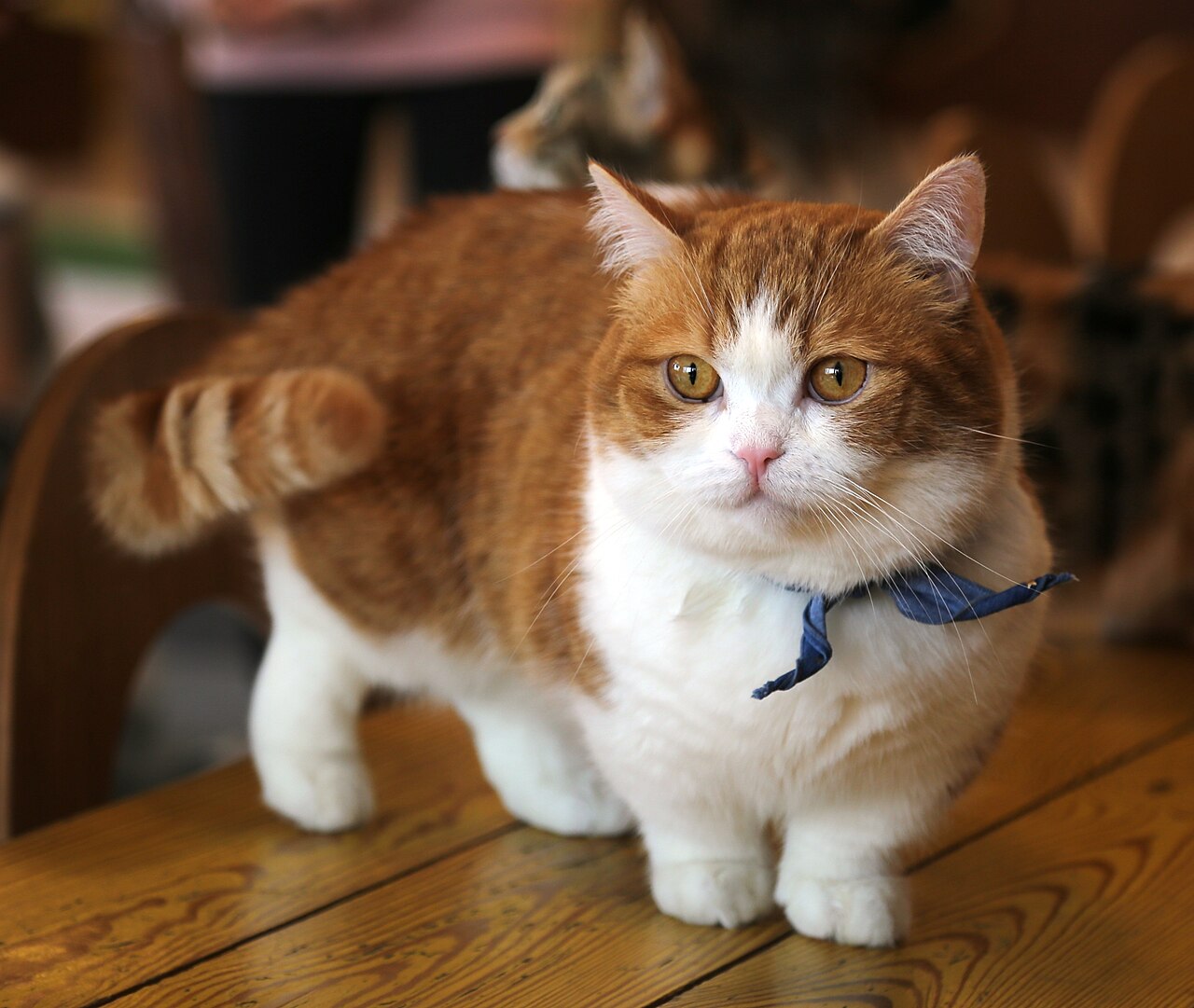

- Type
- Type or coat pattern
- Life span
- 12–15 years
- Status
- Not recognised by the major registries except TICA
A dwarf cat is not a breed but a type of domestic cat: one whose legs are much shorter and thicker than normal because of a genetic mutation affecting bone and cartilage. The Munchkin is the original dwarf breed, and several others have been developed from it. The term does not cover cats that are simply small but normally proportioned, such as toy or teacup Persians.
Appearance
Dwarf cats have osteochondrodysplasia, a disorder of bone and cartilage growth, of which achondroplasia is one form. The result is a cat of roughly normal body size on very short legs. The Munchkin stands about three inches (8 cm) lower than an average cat. The bones may be abnormally shaped, and the legs, the front ones especially, can bow outward.
Breeds
The Munchkin was recognised by The International Cat Association (TICA) in 1994. Crossing it with other breeds has produced a number of short-legged varieties. The Minuet, also called the Napoleon, is a longhaired dwarf from a Persian cross. The Skookum comes from the LaPerm, the Bambino and the Minskin from the Sphynx, the Lambkin from the Selkirk Rex, the Kinkalow from the American Curl, the Genetta from the Bengal and the Scottish Kilt from the Scottish Fold.
Proposed breeds such as the Skookum and Bambino have not been given recognition, and the Minskin is still under study.
Temperament
In behavior dwarf cats may be no different from other cats. They can be playful, curious and quick on their feet.
Care and health
The mutation usually brings health problems with it. Dwarf cats often have spinal disorders such as lordosis, an exaggerated curve of the spine, and pectus excavatum, a sunken chest. They typically live 12 to 15 years.
A cat that looks dwarfed may in fact have another condition. Congenital hypothyroidism produces similar signs, including disproportionate growth and skeletal abnormalities, and can be told apart by a blood test of thyroid hormone levels. X-rays, bone samples and genetic tests are used to confirm true dwarfism.
Recognition and breeding bans
Short-legged cats have become popular, helped by well-known internet cats, but breeding them is widely regarded as unethical because of the lifelong effects on the animals. Apart from TICA, the major registries neither recognise dwarf breeds nor allow crosses with them, and FIFe’s rules name the Munchkin as an example of a breed based on genetic disease. Dwarf cats are mostly bred in the United States.
Breeding them is prohibited in the Netherlands (since 2014) and in the Australian state of Victoria, and the Australian Capital Territory regards it as unacceptable. It is also in effect banned in the European Union under the European Convention for the Protection of Pet Animals.
Facts on this page were checked against Wikipedia and may have changed since.