Cat breedsType or coat pattern
Moggy

- Type
- Type or coat pattern
- Coat
- Any length, from short to long
- Colors
- All colors and patterns; tabby is common
- Status
- Not a breed; some registries admit them to household pet classes
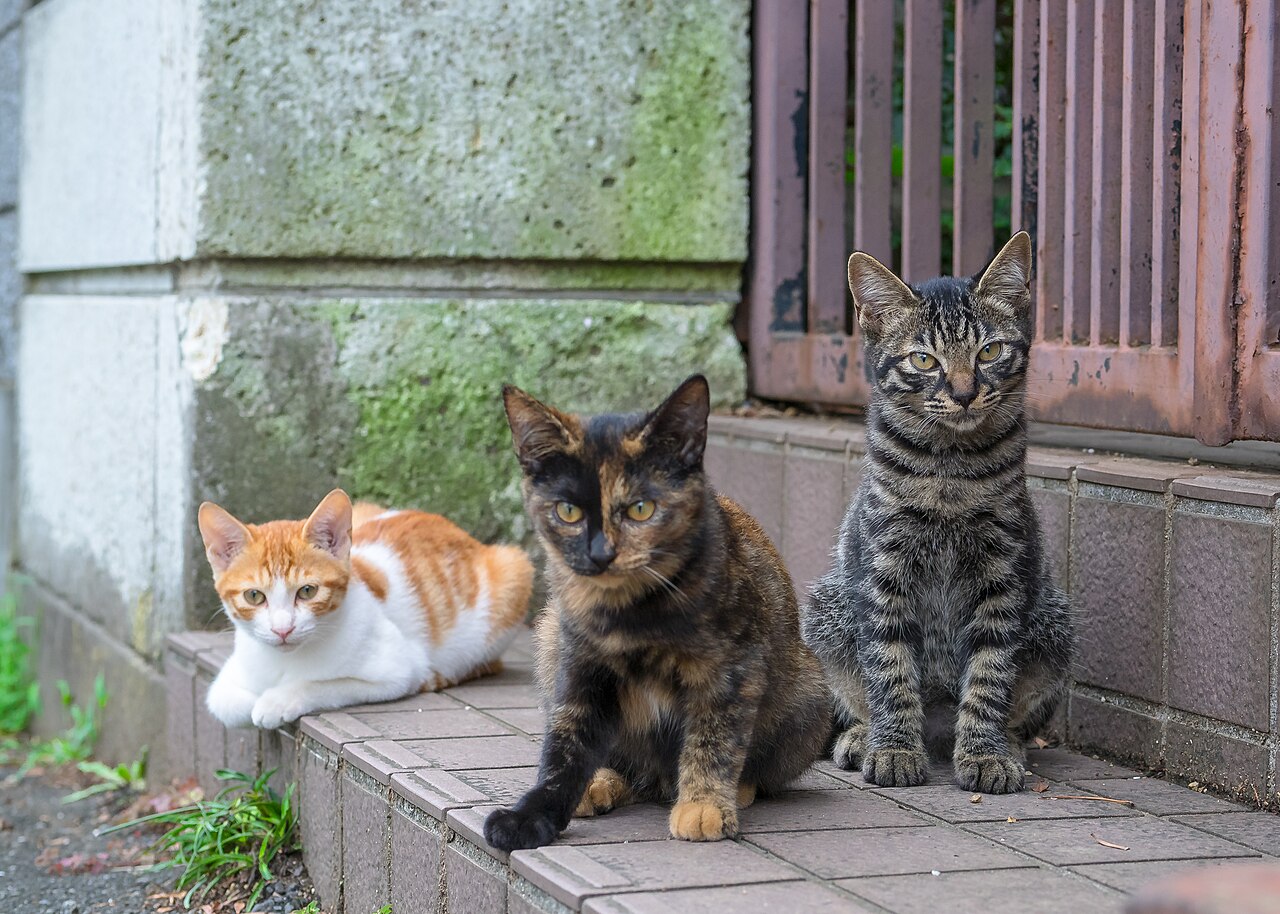
A moggy is not a breed. The word, mainly British, means any cat that has not been intentionally bred, and so has no pedigree. Where a cat has to be described on paper, at a vet’s or in a shelter, a moggy is usually entered as a domestic shorthair (DSH) or domestic longhair (DLH), according to its coat. In American English the everyday term is alley cat.
History
Nearly all the world’s cats are moggies. Pedigree breeds are a human invention of roughly the last 150 years, and more than 85 percent of them have appeared since the 1930s. In the United States fewer than 2 percent of cats are purebred; in France about 4 percent are pedigreed; in the United Kingdom 89 to 92 percent of cats are non-pedigree. Worldwide the share of moggies is put at 98 to 99 percent.
Longhaired domestic cats seem to have originated in western Asia. The first were brought to Europe in the 16th century and were documented in Italy by 1521. The long coat is thought to stem from a recessive gene: a longhaired cat mated to a shorthair has shorthaired kittens, but those kittens can produce longhaired young in turn. The Persian and the Angora were the first formal longhaired breeds.
Appearance
Moggies have no set look. Domestic shorthairs come in every color, and after a few generations of free breeding they tend to return to a tabby pattern. Body type varies by region, because local cat populations grew from different stock: Asian shorthairs are often built like a classic Siamese or Tonkinese, while European and American ones are thicker and heavier.
Domestic longhairs have semi-long to long fur, as much as six inches (15 cm) in length, in any color, including tabby, tortoiseshell, bicolor and smoke. Some have a ruff like a Maine Coon’s, along with tufted ears and toes. They should not be confused with breeds that have “Longhair” in their names.
Some cat shows have household pet classes open to non-pedigree cats. Rules differ: FIFe accepts any color, coat and tail length, while the World Cat Federation excludes chocolate, cinnamon and pointed coats.
Care and health
Some longhaired cats cannot keep their own coats in order and need regular grooming to prevent matting.
Thanks to their broad gene pool, domestic longhairs are not predisposed to any inherited conditions. A study of UK veterinary records found that moggies lived significantly longer than pedigree cats, and a Japanese study of insurance records found every category of disease except dental disease and injuries to be more common in purebreds.
Facts on this page were checked against Wikipedia and may have changed since.