Cat breedsType or coat pattern
Squitten
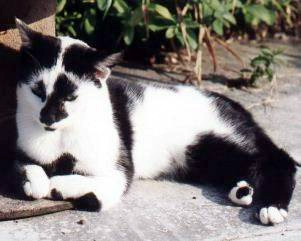

- Type
- Type or coat pattern
- Status
- Not recognised by the major registries
“Squitten” is not a breed. It is an informal name for a domestic cat born with a deformity of the forelegs, in which the radius bone is only partly formed or missing altogether. Such a cat tends to sit up on its haunches like a squirrel, and the word joins “squirrel” and “kitten”. A rarer name, “kangaroo cat”, goes back to a specimen recorded in 1953 and known as the Stalingrad Kangaroo Cat.
Appearance
The name covers several related conditions: radial hypoplasia (an underdeveloped radius), radial aplasia or agenesis (a radius that is absent or failed to form) and foreleg micromelia (abnormally small forelegs). Affected cats have unusually short front legs, with the radius and ulna shortened, twisted or missing, often extra front toes, and hind legs of normal length.
A squitten moves rather like a ferret and often sits on its rump with its front paws off the ground. Some get about with a hopping gait on the hind legs.
A mild form of radial hypoplasia can show itself only as a particular kind of extra toes: large paws with additional three-jointed toes on the outer side and no thumb, sometimes called “patty feet” or “hamburger feet”. The common thumb-type polydactyl cats are not affected. X-rays can show which form a cat has. A matching condition of the hind legs, femoral hypoplasia, has been reported in cats only three times.
Care and health
The short or twisted forelegs limit movement. Affected kittens may not be able to knead properly, which matters because kneading stimulates the mother’s milk.
When the condition is found early, splints can bring the limb closer to its normal position and help prevent fractures of the ulna, stiffened joints and muscle wasting. Because the patients are usually growing kittens, the splints have to be adjusted often and kept on until the skeleton is mature. Severe cases may call for surgery, including fusing the wrist joint or amputation. Vets recommend that these cats live indoors and be monitored over the long term; with proper care most have a good quality of life.
Breeding and ethics
The mutation turns up naturally among random-bred cats, especially in inbred groups where recessive genes come to the surface. In the late 1990s a number of such cats, called “Twisty Cats”, were deliberately bred at Karma Farms in Marshall, in the United States, which caused a public outcry.
The exact cause is unclear but appears to be genetic, so breeding from affected cats is not recommended. Many major registries neither recognise these cats nor allow them in their breeds, on welfare grounds. The European Convention for the Protection of Pet Animals in effect bans such breeding in the European Union, and Austria, the Netherlands and the Australian state of Victoria and the Australian Capital Territory prohibit breeding from an affected parent.
Facts on this page were checked against Wikipedia and may have changed since.