Norwegian Forest Cat

- Origin
- Norway
- Type
- Longhair
- Size
- Large
- Weight
- 3.6–9 kg (7.9–19.8 lb)
- Coat
- Long, glossy, water-repellent top coat over a woolly undercoat
- Colors
- All colors
- Status
- Recognised by FIFe and the ACFA
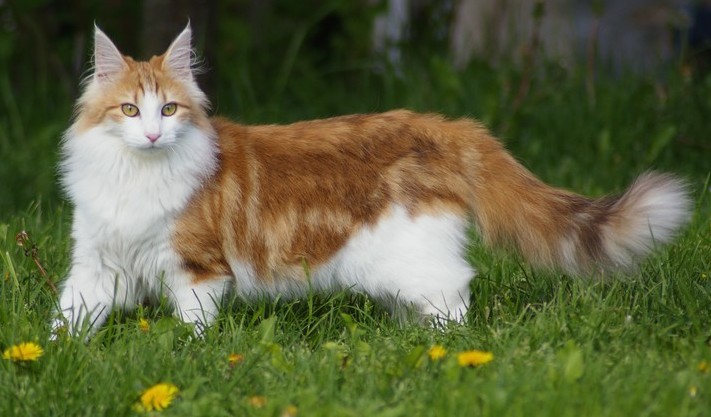
The Norwegian Forest Cat is a large longhaired breed from Northern Europe. It developed naturally in Norway and is built for a very cold climate, with a long, glossy top coat over a woolly, insulating undercoat. It is most popular in Europe, especially in Norway, Sweden, Denmark, Iceland and France.
History
The breed’s ancestry is a matter of likelihood, not record. Its forebears may include short-haired cats that the Vikings brought to Norway around or after AD 1000, perhaps from Great Britain, and long-haired cats brought by Crusaders around the fourteenth century. The Siberian and the Turkish Angora are also possible ancestors. These cats would have bred with farm and feral cats and adapted to the climate over time.
The cats lived in the Norwegian forests for centuries and were later kept on farms for their hunting, until cat enthusiasts took notice of them in the early twentieth century. The first club for the breed, the Norwegian Forest Cat Club, was founded in Oslo in 1938. World War II interrupted its work, and crossbreeding with free-roaming cats during the war brought the type close to extinction. The club then set up an official breeding program that brought it back.
In the 1950s King Olav V named it the official cat of Norway. The breed did not leave Norway until the 1970s, when the Norwegian fancier Carl-Fredrik Nordane worked to have it registered with FIFe. Sweden recognised it in 1978, Britain accepted it in 1989, and the American Cat Fanciers Association in 1994.
Appearance
The Norwegian Forest Cat is strongly built and bigger than an average cat. Females weigh 3.6 to 8 kg (7.9 to 17.6 lb) and males 4.5 to 9 kg (9.9 to 19.8 lb). The body is long and sturdy, the legs are long and the tail is bushy.
The top coat is long, thick, glossy and water-repellent, and the undercoat is woolly. The coat is thickest on the legs, chest and head, where it forms a ruff. All coat colors are accepted.
The head is long and shaped like an equilateral triangle, with a strong chin, a medium-length muzzle and a straight profile. The eyes are almond-shaped, set at a slant, and may be any color. The ears are large, wide at the base and set high, and end in tufts like a lynx’s.
Temperament
These cats are friendly, intelligent and generally good with people, and they have a lot of energy. Fanciers note that they make a range of high-pitched chirping sounds. Their strong claws make them very good climbers, even on rock. Those that live mostly outdoors become quick, effective hunters, but the breed can also adapt to life indoors.
Care and health
Glycogen storage disease type IV, a rare inherited disorder that can be fatal, has been found in the breed. Norwegian Forest Cats are also known to suffer from hip dysplasia. A study of English pedigree records found evidence of hereditary cardiomyopathy, and another study suggested that eosinophilic granuloma complex runs in families.
Facts on this page were checked against Wikipedia and may have changed since.